
What would change in the ledger? As reported by Odaily on November 5, 2026, Polymarket and Binance had proposed a Polygon PoS hard fork that would set the balances of five frozen addresses to zero and credit the same amount—about 70.49 million POL—to recovery addresses they designated. The proposed adjustment would leave total POL supply unchanged. It was a proposal, not a completed recovery.
Odaily reported that Polygon validators froze four addresses associated with an October 30 compromise of Polymarket’s front end, holding 23.86 million POL, and one address associated with a compromise of a Binance hot wallet, holding 46.63 million POL. The freeze restricted movement from those addresses; it did not change their balances or return the assets. The report initially valued the combined amount at about $6.7 million, while a later passage estimated it at about $6.5 million.
According to the proposal as described by Odaily, Polymarket had sought the attacker’s cooperation without receiving a response. The proposal also alleged that the attacker offered Polygon validators cash to unfreeze addresses. Those claims are attributed to the proposal, not independently established by the reported on-chain balances.
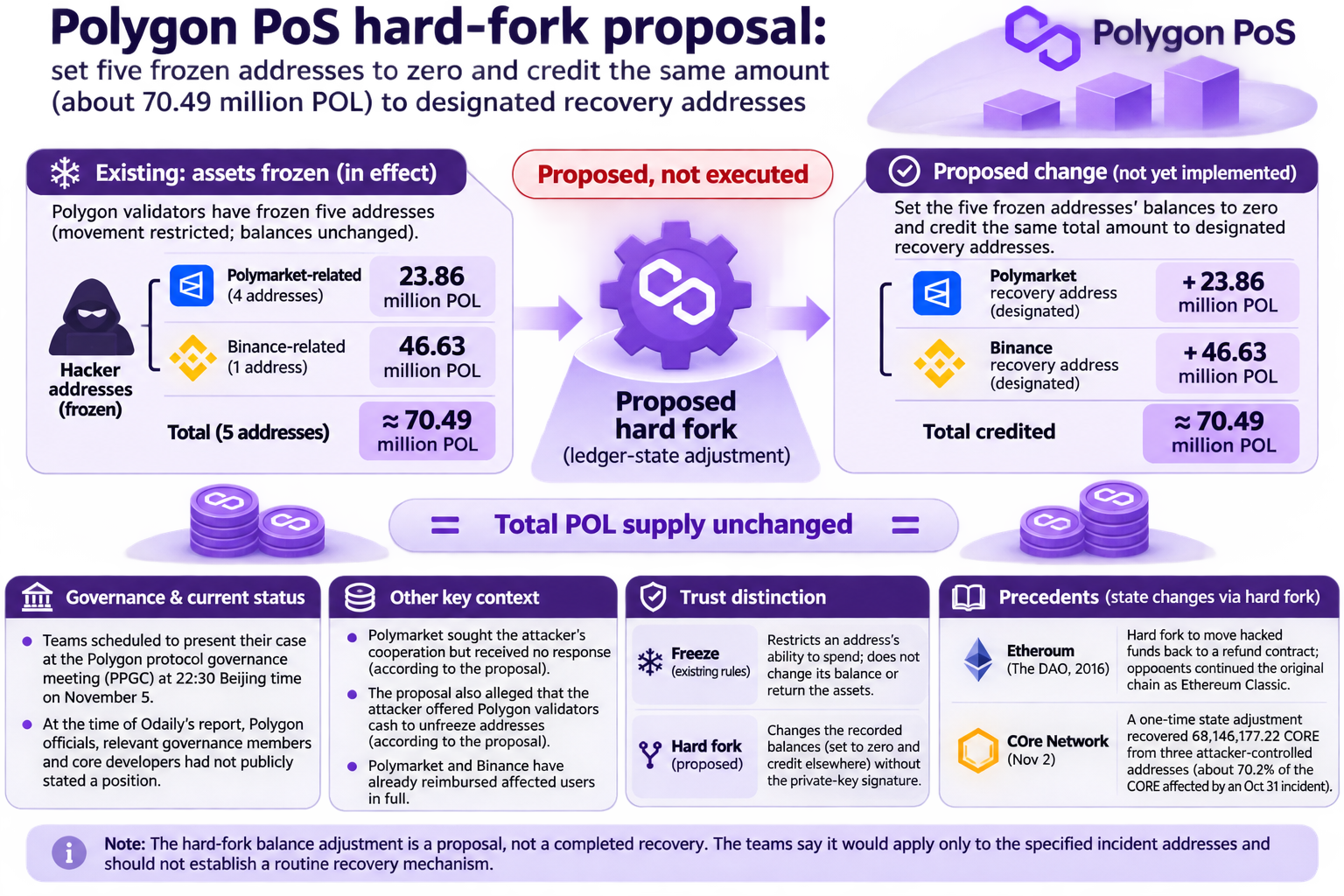
The teams were scheduled to present their case at a Polygon protocol governance meeting at 22:30 Beijing time on November 5. At the time of Odaily’s report, Polygon officials, relevant governance members and core developers had not publicly stated a position. Odaily also reported that Polymarket and Binance had already reimbursed affected users in full.
The trust distinction is whether an address can spend under existing rules or whether a hard fork can change its recorded balance without its private-key signature. Polymarket and Binance said the proposed adjustment would apply only to the specified incident addresses and should not establish a routine recovery mechanism. Odaily argued that making such an exception could nonetheless affect confidence in Polygon’s rules; that is an assessment, not an observed outcome.
Hard-fork recoveries have precedents. Odaily cited Ethereum’s 2016 response to The DAO exploit, which led opponents of the fork to continue the original chain as Ethereum Classic. It also cited Core Network’s announcement on November 2 that a one-time state adjustment recovered 68,146,177.22 CORE from three attacker-controlled addresses—about 70.2% of the CORE affected by an October 31 incident. Those cases show what a state change can do, but do not establish what Polygon would decide.