What does a launch platform earn when a token trades briefly but never develops a lasting market? In an analysis published on November 12, 2026, on-chain research team Sparsity argued that Pump.fun’s fees reward early trading activity more directly than token survival. Its figures were approximate and used data through November 9, 2026.
Where the reported fees came from
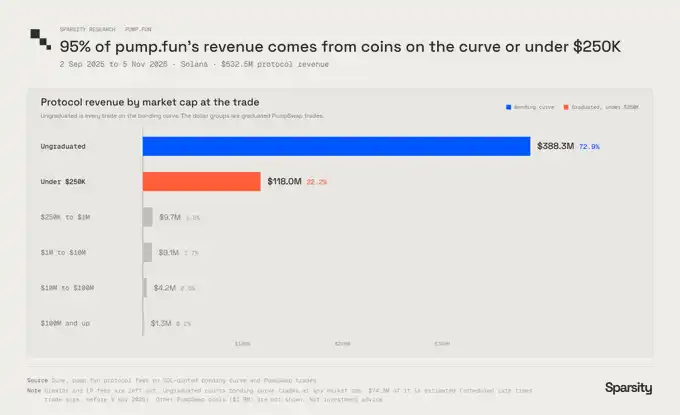
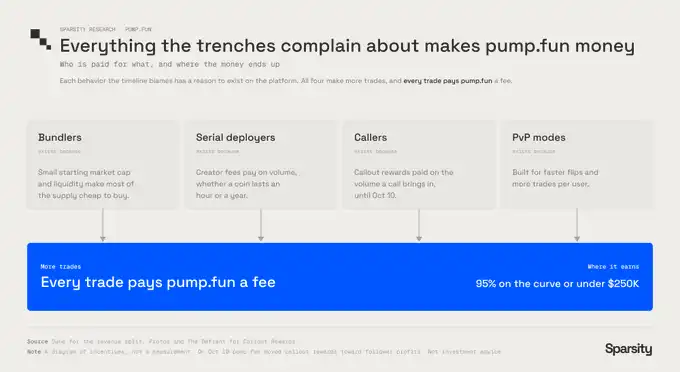
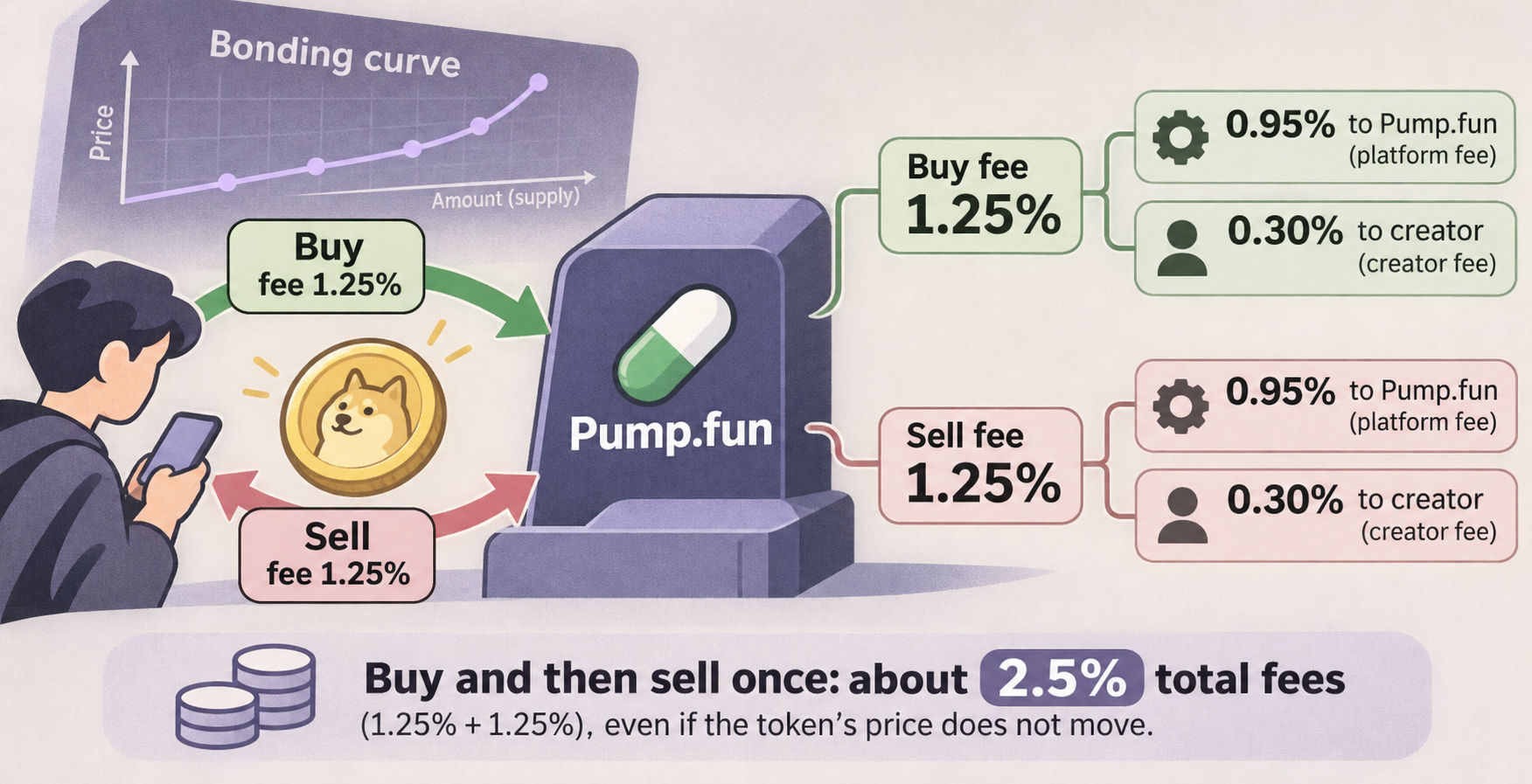
Sparsity estimated that 95% of Pump.fun’s protocol revenue came from tokens still on the bonding curve or valued below $250,000. On the bonding curve—the pricing mechanism used during an early launch—each buy and sell incurred a 1.25% fee: 0.95% for Pump.fun and 0.30% for the creator. A buy followed by a sale would therefore incur about 2.5% in fees even if the token’s price did not move.
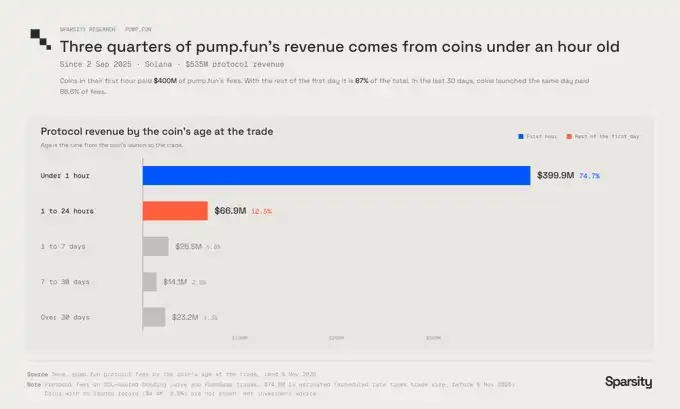
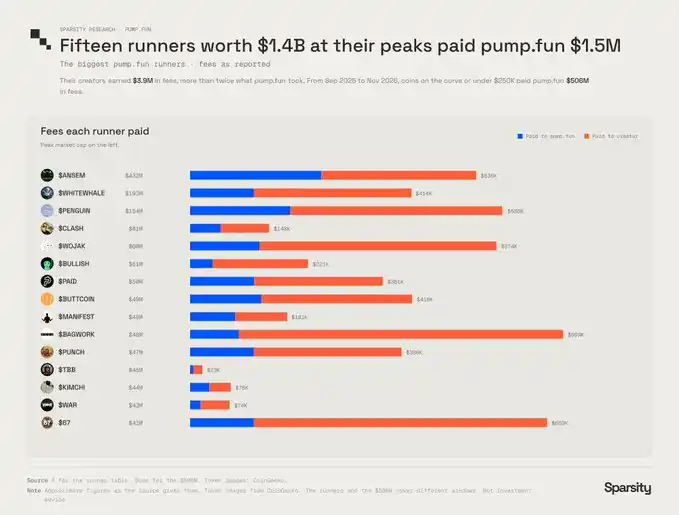
By token age, Sparsity said three-quarters of that revenue came from tokens less than an hour old, and 87% from tokens less than a day old. It reported roughly $506 million in revenue from bonding-curve or sub-$250,000 tokens, versus about $1.5 million from a group of 15 tokens whose combined peak market capitalizations reached $1.4 billion. These are revenue comparisons, not measures of what individual buyers earned.
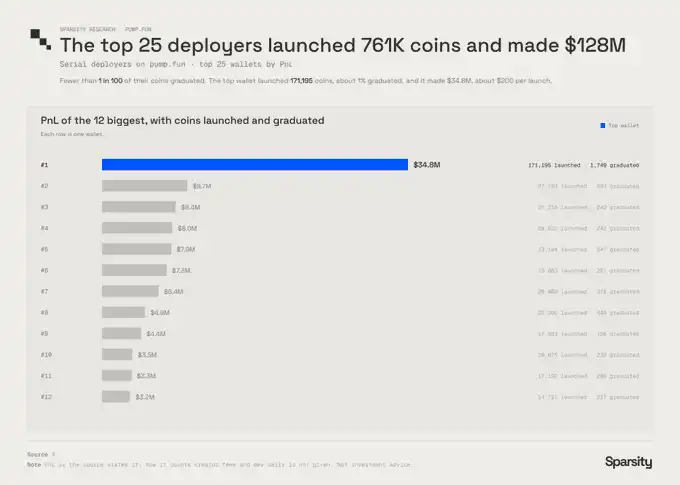
The analysis also linked creator fees to repeated launches. Its 25 highest-volume issuing wallets collectively launched 761,000 tokens; fewer than 1% graduated from the bonding curve, while the wallets earned a reported $128 million. A wallet count does not establish how many distinct people controlled those wallets.
Promotion rewards and buyer outcomes
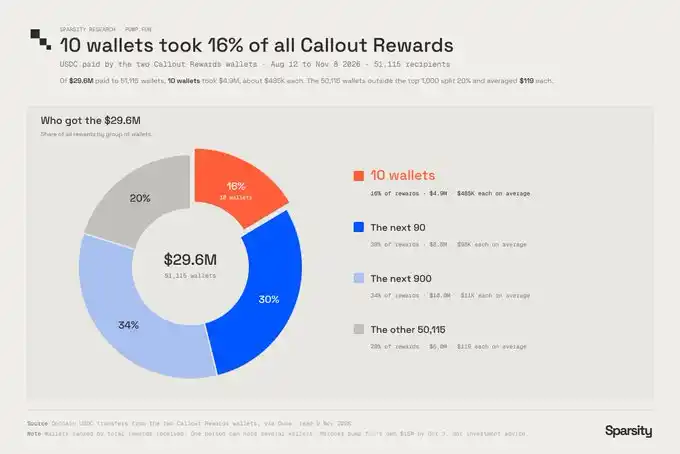
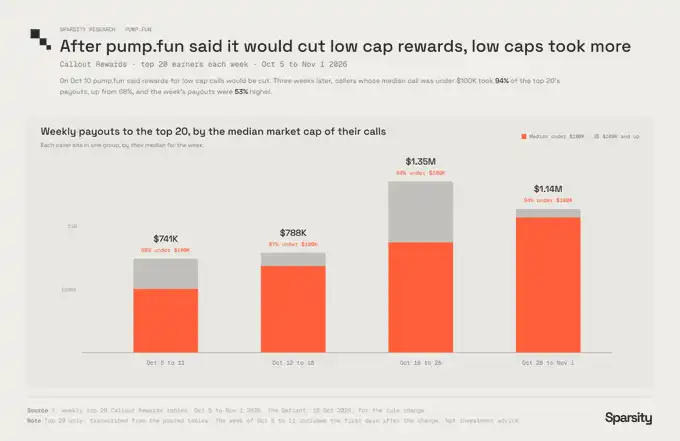
Sparsity said Pump.fun had paid $29.6 million in promotion rewards to 51,115 wallets since August. On October 10, the platform said future rewards would take followers’ profitability into account and reduce rewards for promoting low-market-cap tokens. Yet in the following three weeks, Sparsity found that promoters whose promoted tokens had a median market capitalization below $100,000 received 94% of rewards paid to the top 20 recipients, up from 68% before the change. Weekly rewards rose 53% over that comparison. Those observations describe the measured outcome; they do not, by themselves, establish why it occurred.
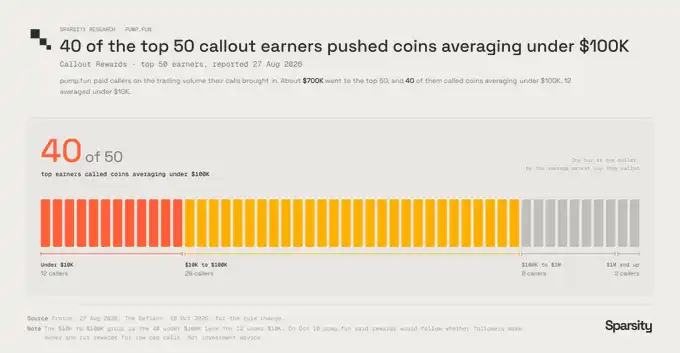
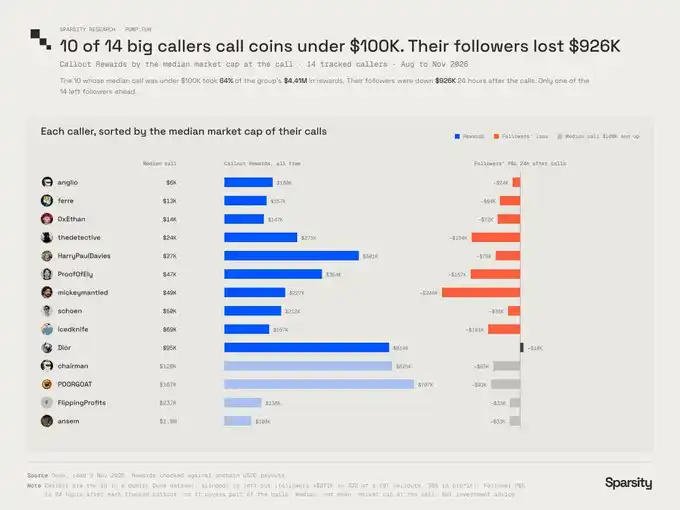
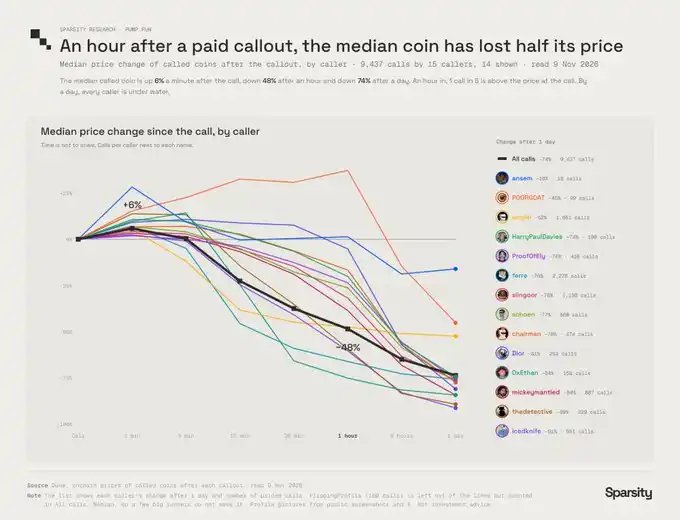
In a separate sample of 14 promoters, Sparsity reported that followers collectively lost $926,000 one day after the posts. The median price change for promoted tokens was up 6% after one minute, down 48% after one hour and down 74% after one day. The sample does not establish the result for every promoter or buyer.
Launch volume versus lasting markets
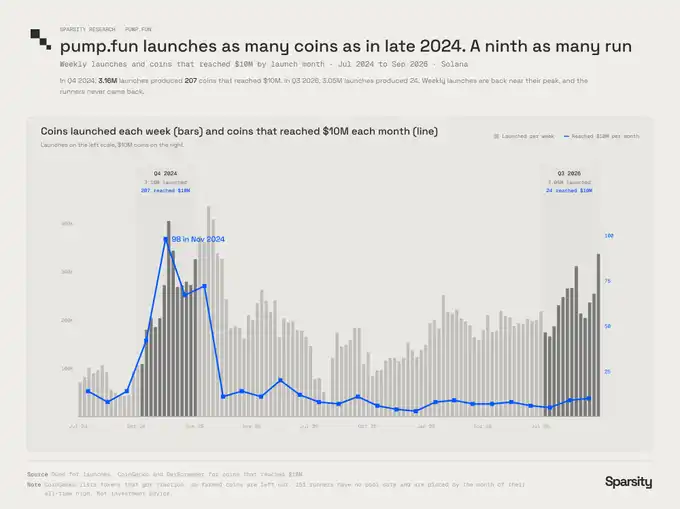
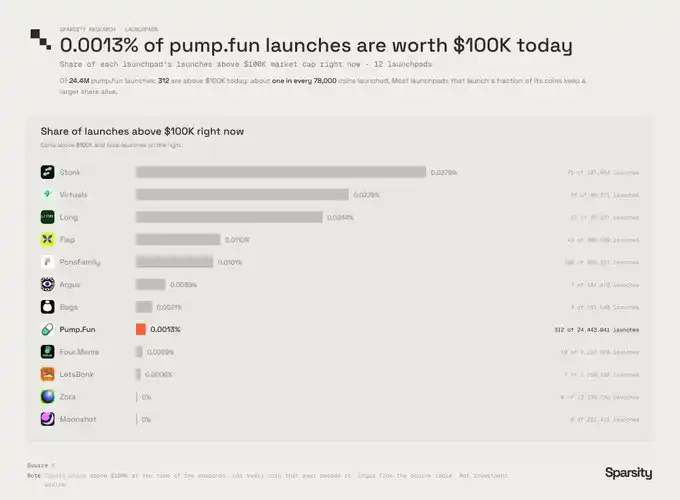
Sparsity counted 3.16 million Pump.fun token launches in the fourth quarter of 2024, of which 207 reached a $10 million market capitalization at some point. In the third quarter of 2026, it counted 3.05 million launches but only 24 that reached the same threshold—approximately 6.5 versus 0.8 per 100,000 launches. It also reported that, among 24.4 million tokens ever launched on the platform, 312 still had market capitalizations above $100,000 at the time of its analysis. These thresholds describe different measures: ever reaching $10 million is not the same as remaining above $100,000.
Sparsity’s interpretation is that fees on early transactions can reward the platform and issuers even when buyers cannot find a later market for the token. That is its argument about incentives, not proof that the fee model alone caused the decline in tokens reaching $10 million.
A proposed alternative, not an enacted rule
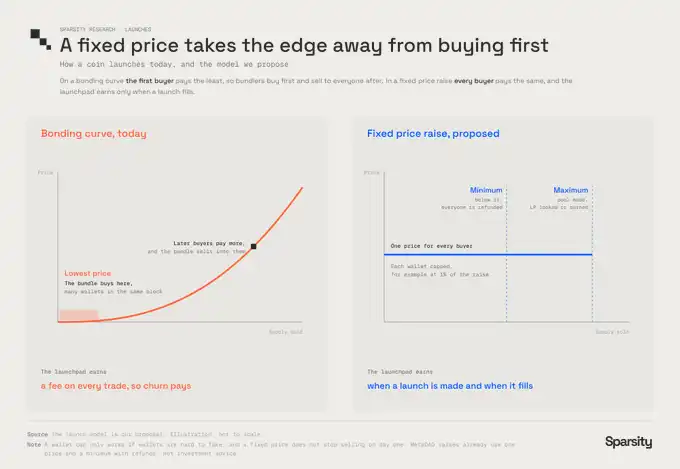
The analysis proposed replacing the bonding-curve launch with fixed-price subscriptions. Under the suggested design, buyers would pay the same price; a contract would refund them if a minimum fundraising target were not met within a set period, such as 24 or 48 hours. If the proposed fundraising cap were reached, the contract would create a liquidity pool and lock or burn its LP tokens. The platform would collect a fee only when fundraising filled.
Sparsity also suggested a per-wallet contribution limit, while acknowledging that one participant could split purchases among multiple wallets. Fixed pricing would not prevent immediate selling after launch. No deployment or adoption of this design was reported.