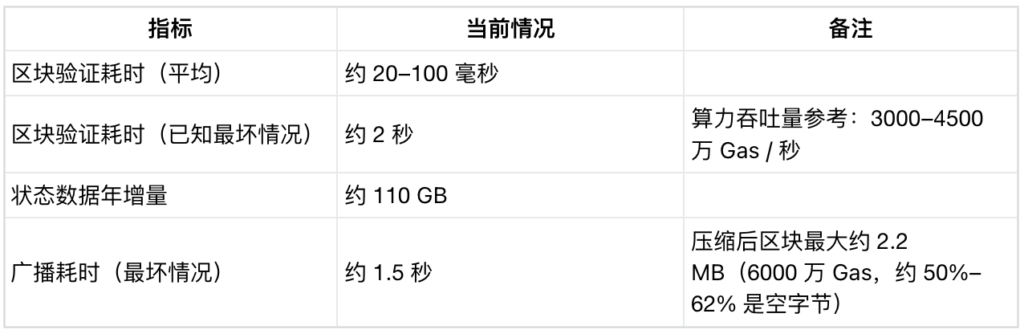
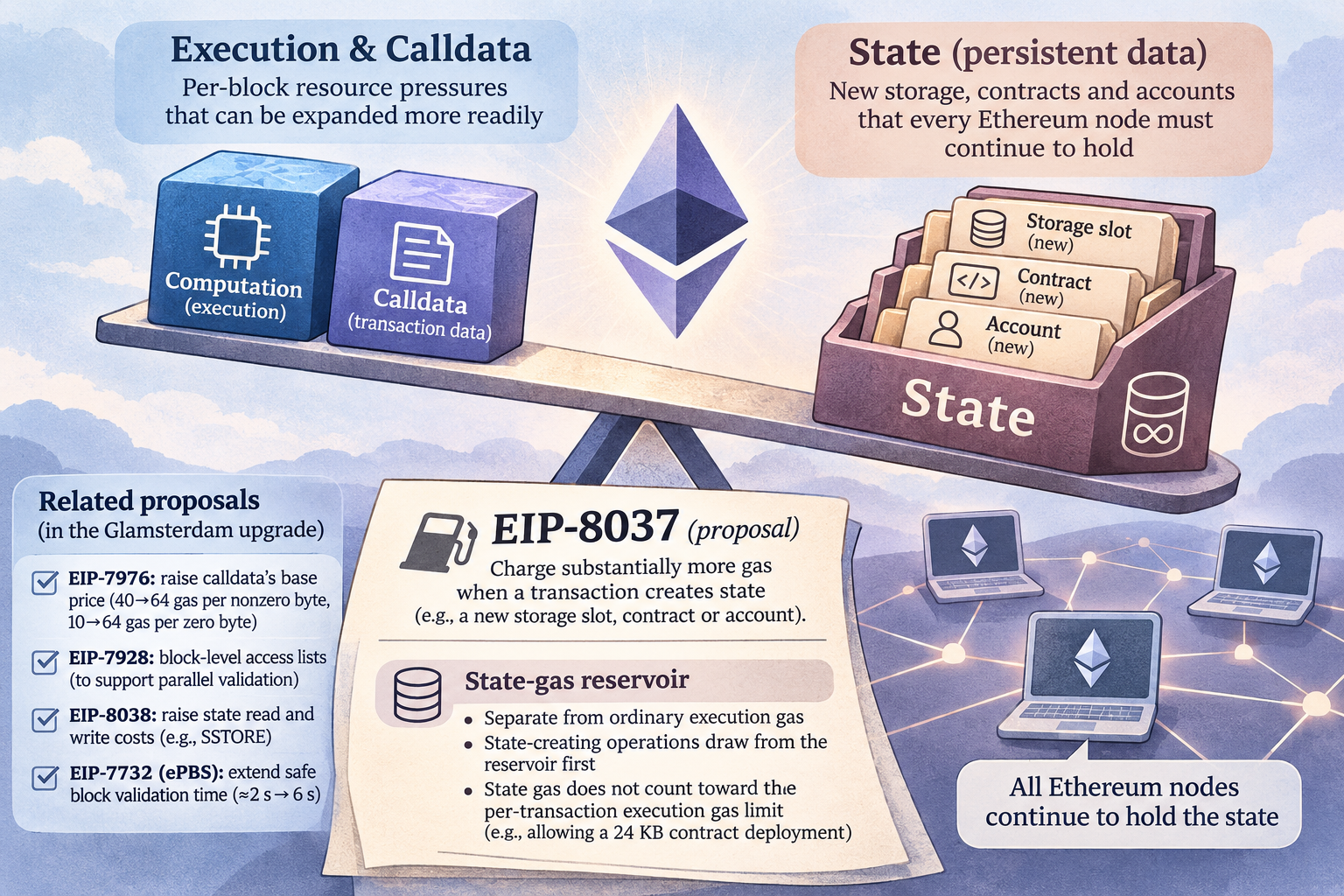
A transaction can require little computation yet leave data that every Ethereum node must continue to hold. That difference is central to EIP-8037, a proposal to charge substantially more gas when a transaction creates state, including a new storage slot, contract or account.
In an article published on November 16, 2026, Vitalik Buterin argued that Ethereum could expand execution capacity much more readily than it could accommodate persistent state growth. His case for EIP-8037 is an argument about how to price those different burdens—not a report that the proposal has already taken effect.
Why a higher gas limit is not enough
Buterin’s thought experiment starts with a tenfold increase in the gas limit. Without other changes, he says, that would also increase pressure on block validation, block propagation and state storage. He considers the last of these the hardest constraint: a larger state raises disk requirements, slows synchronization and can make state reads and writes slower.
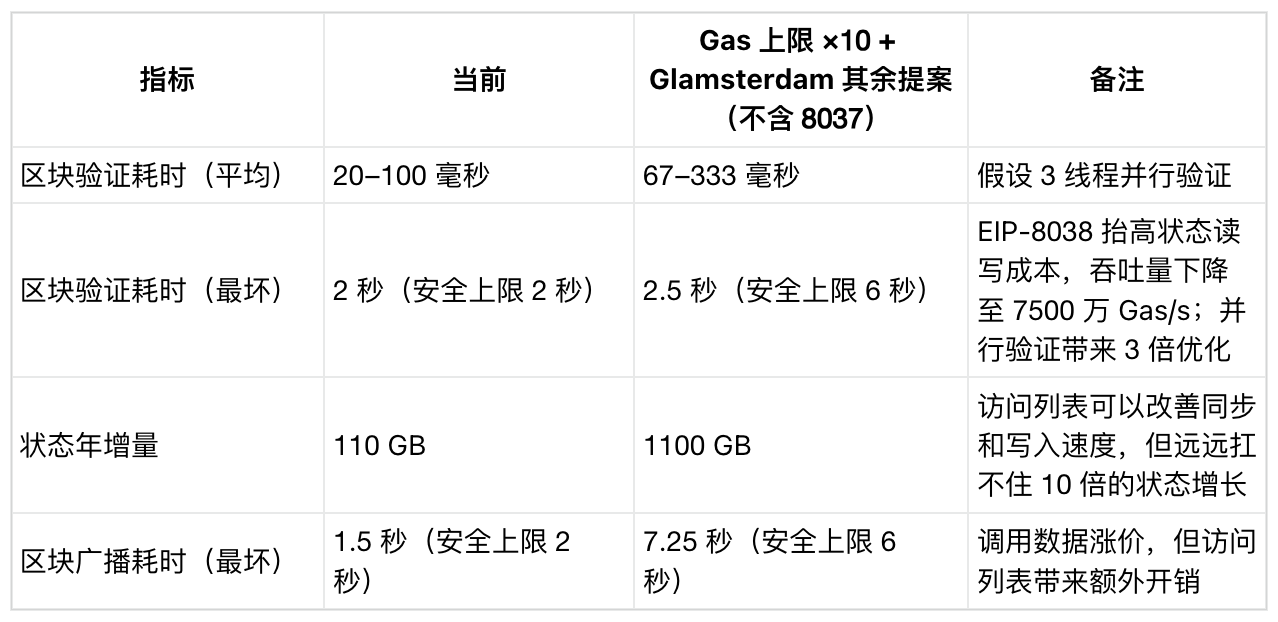
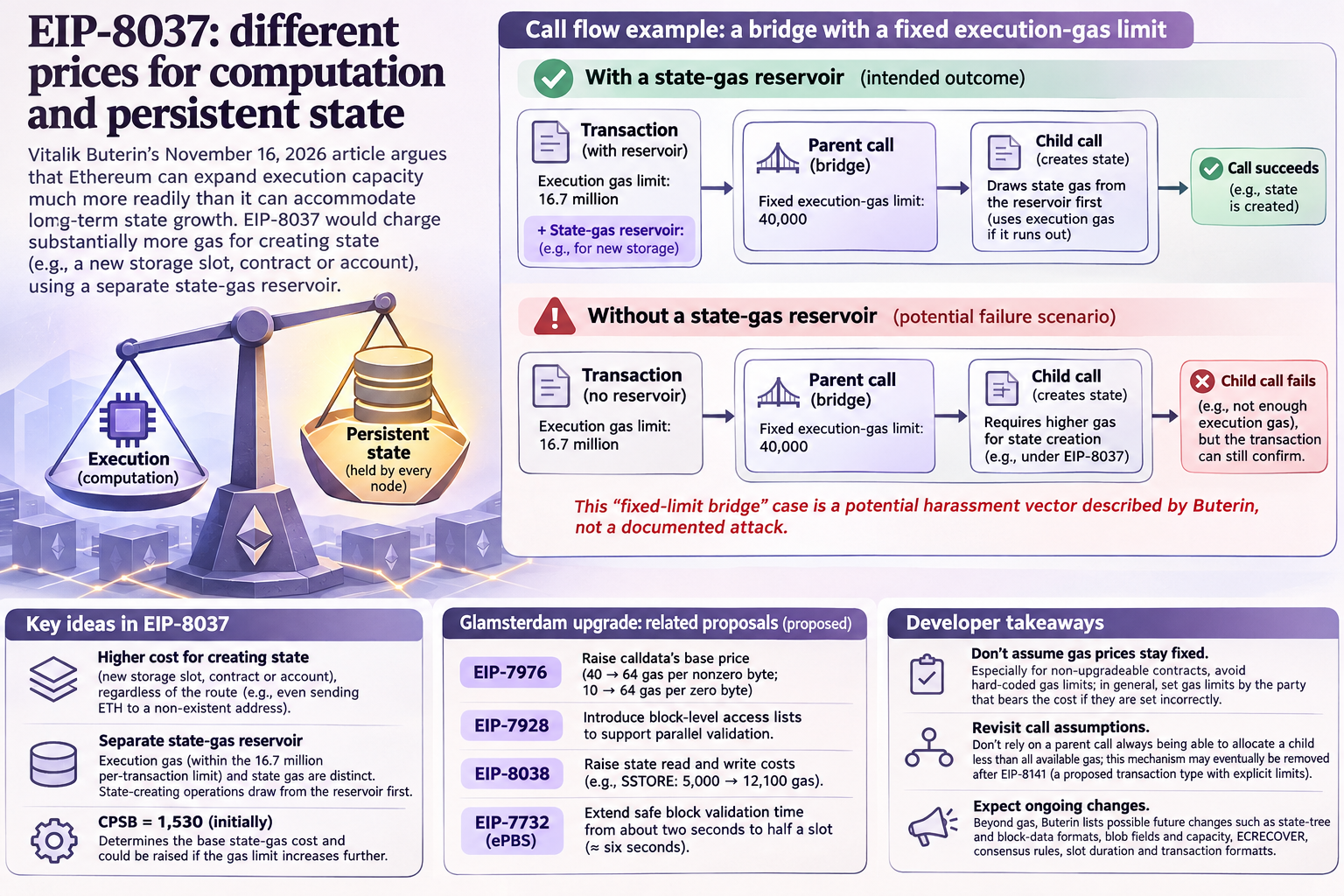
He places EIP-8037 alongside other proposals in the Glamsterdam upgrade package. EIP-7976 would raise calldata’s base price from 40 to 64 gas per nonzero byte and from 10 to 64 gas per zero byte. EIP-7928 would introduce block-level access lists to support parallel validation. EIP-8038 would raise state read and write costs, while EIP-7732, or ePBS, would extend the time available for safe block validation from about two seconds to half a slot, or six seconds.
In Buterin’s assessment, those changes, together with further planned work, could make a much higher gas limit manageable for computation and calldata. They do not, in his view, adequately constrain the amount of new state. That is the specific gap EIP-8037 is intended to address.
What the proposal would charge
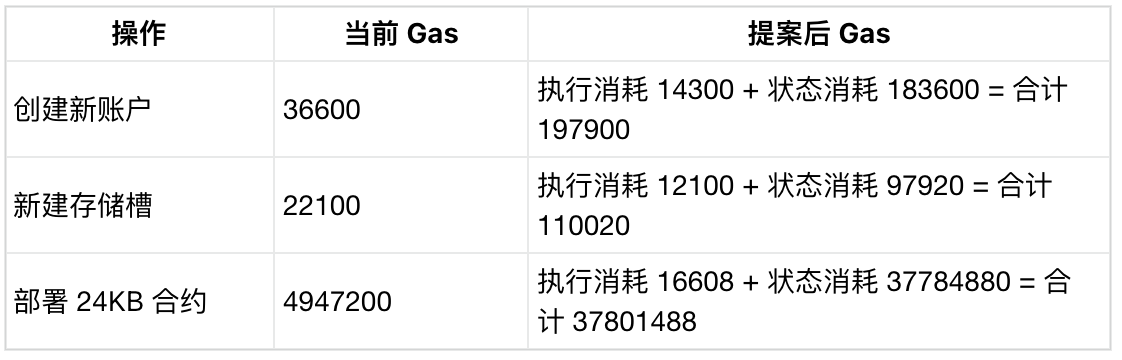
EIP-8037 would increase the cost of creating state regardless of the route used. Buterin notes that sending ETH to an address that does not yet exist would incur the new-account charge, rather than provide a way around it. The proposal’s CPSB parameter, which determines the base state-gas cost, would initially be 1,530 and could be raised if the gas limit increased further.
The design separates ordinary execution gas from a state-gas reservoir. As Buterin describes it, gas within a transaction’s 16.7 million limit is ordinarily execution gas; additional gas can be supplied through the reservoir. State-creating operations draw on the reservoir first and use execution gas if it runs out. State gas would not count toward that 16.7 million per-transaction limit, allowing, for example, a 24 KB contract deployment to remain possible despite a higher state-creation charge. A child call could use the reservoir even when its parent limits the child’s execution gas.
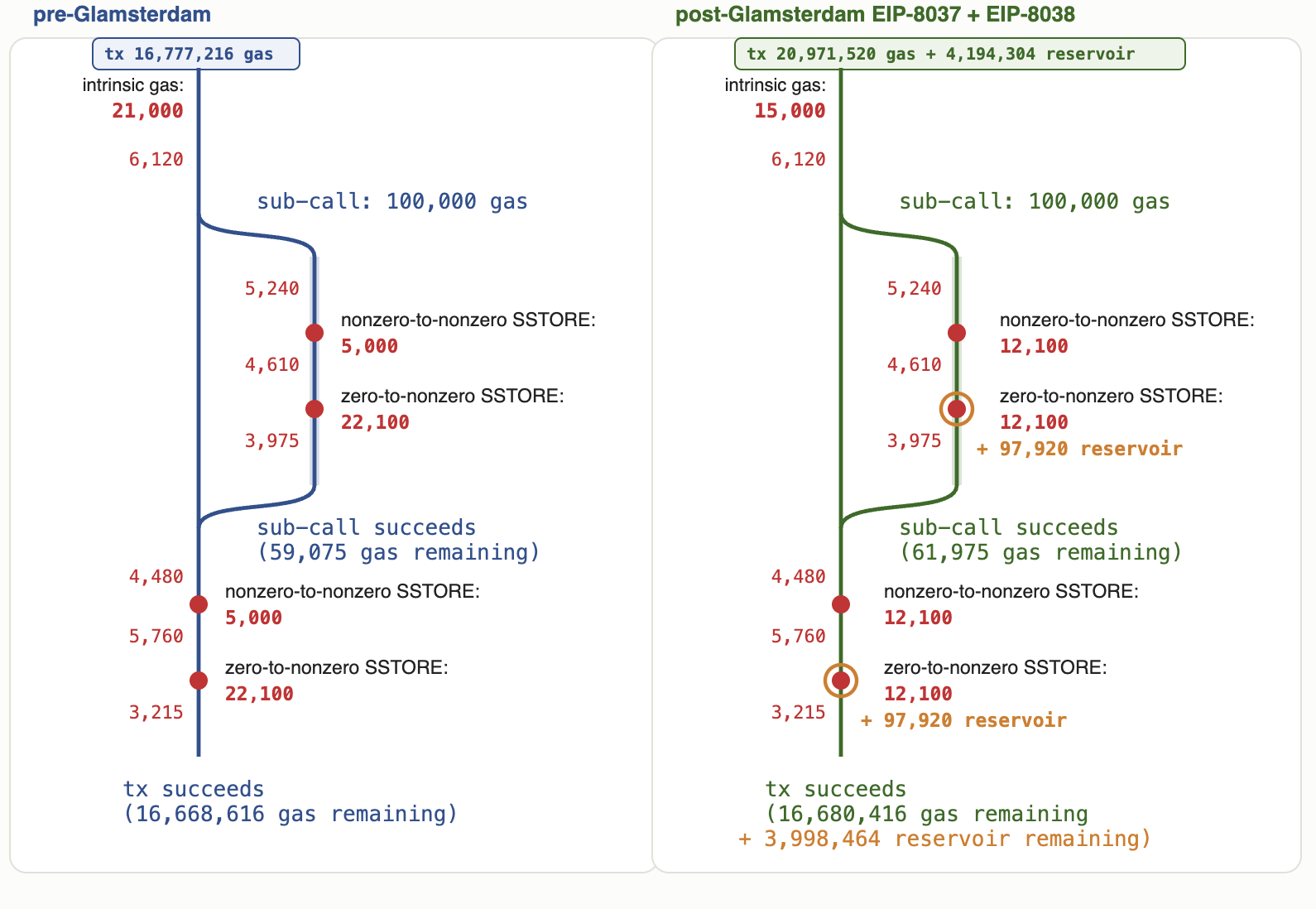
Buterin presents this as a step toward multidimensional gas pricing: execution and persistent state would no longer have to be treated as if they imposed the same kind of network cost. He says the proposed EIP-8141 transaction type would let a transaction specify the two limits explicitly. That is a prospective improvement, not a capability the article says is already available.
Compatibility risks, including bridges
Separating gas costs does not make existing application assumptions disappear. Buterin identifies systems with hard-coded gas limits as particularly difficult to adapt. In his OP Stack bridge example, logic with a fixed 40,000-gas limit could be disrupted by a transaction sent without a state-gas reservoir: the intended call could fail while the transaction itself still confirms. He describes this as a potential harassment vector, not as an observed exploit in the article.
He also flags a proposed change to make gas refunds immediate rather than settle them at transaction end; that could alter values returned by the GAS instruction. Separately, he says EIP-8038’s proposed increase in SSTORE cost from 5,000 to 12,100 gas has no reservoir to cushion affected contracts. Once a reservoir is used, GAS would not accurately measure a child call’s total consumption, and ERC-4337 UserOperation compatibility would require special work.
Buterin discusses possible protocol remedies—including changing refund timing, withdrawing EIP-8038, extending the reservoir, accelerating EIP-8141, or exempting older contracts—but describes each as carrying costs or risks. He says withdrawing EIP-8038 would reduce the potential scaling headroom by about 2.4 times. Merely starting EIP-8037 with gentler parameters would not, he argues, solve the fixed-limit OP Stack bridge case.
According to Buterin, the prevailing view among core developers at the time of writing was to work with application developers to find and fix affected contracts before Glamsterdam rather than make further major protocol changes. He says Glamsterdam had been delayed, public discussions had taken place, and work to identify and address issues had begun. Those are his descriptions of the response as of the November 2026 article, not claims about the upgrade’s current status.
The assumption developers should revisit
Buterin’s immediate advice for developers of non-upgradeable contracts is not to assume gas prices will remain fixed. In particular, he argues that gas limits should generally be set by the party that bears the cost of setting them incorrectly, rather than hard-coded in an application. He also cautions against assuming that a parent call will always retain the ability to allocate a child less than all available gas; he expects that mechanism may eventually be removed after EIP-8141.
His wider list of possible future changes includes state-tree and block-data formats, blob fields and capacity, ECRECOVER, consensus rules, slot duration and transaction formats. These are expectations and areas for developer caution, not enacted changes. He says EVM execution logic could remain compatible through a compatibility layer even if an underlying instruction set changed, while gas costs would still change. He calls for core developers to publish a clearer shared list of what applications should—and should not—expect to remain stable.