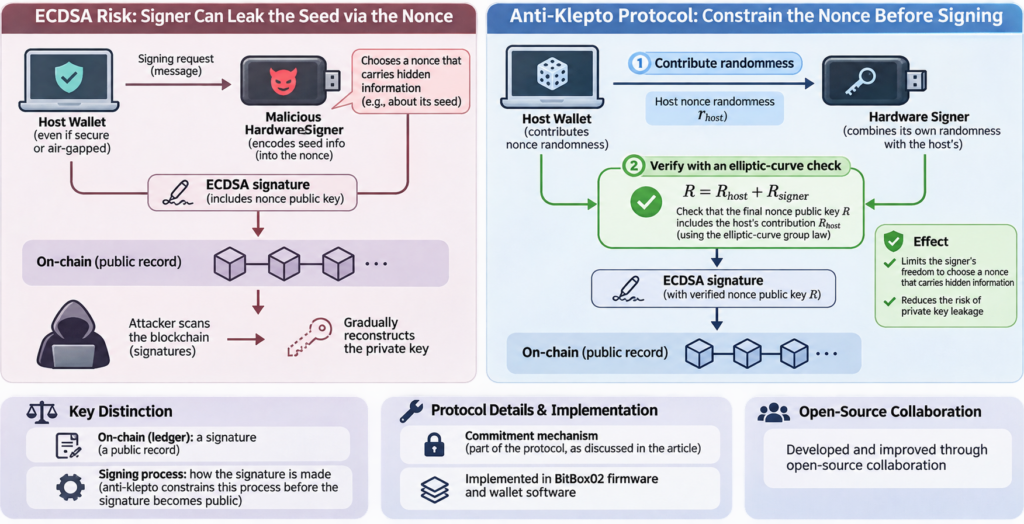
A blockchain signature is a public record, but a hardware signer can also influence how that signature is made. An article published on November 5, 2026, examines a risk in ECDSA signing: a malicious device could encode information about its seed into the nonce public key. Once signatures appear on-chain, an attacker could scan the blockchain and gradually reconstruct the private key. According to the article, a secure host or an air-gapped device would not, by itself, stop that form of leakage.
The anti-klepto protocol changes who controls the nonce. It requires the host wallet to contribute randomness, then uses an elliptic-curve check to verify that the final nonce public key includes the host’s contribution. This limits the signer’s freedom to choose a nonce that carries hidden information.
The article also discusses the protocol’s commitment mechanism and its implementation in BitBox02 firmware and wallet software, including open-source collaboration. The key distinction is between what appears on the ledger—a signature—and the signing process behind it: the protocol is intended to constrain that process before the signature becomes a public record.