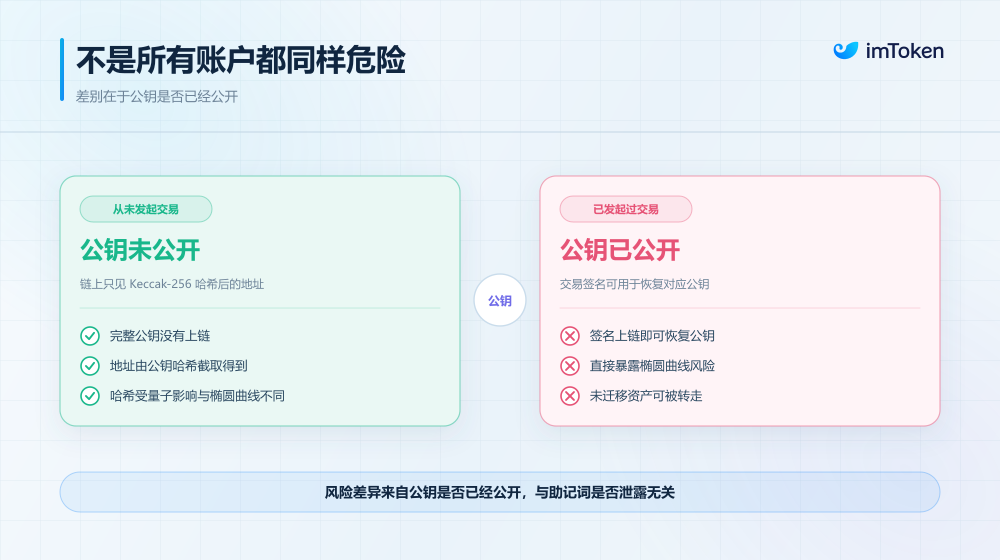
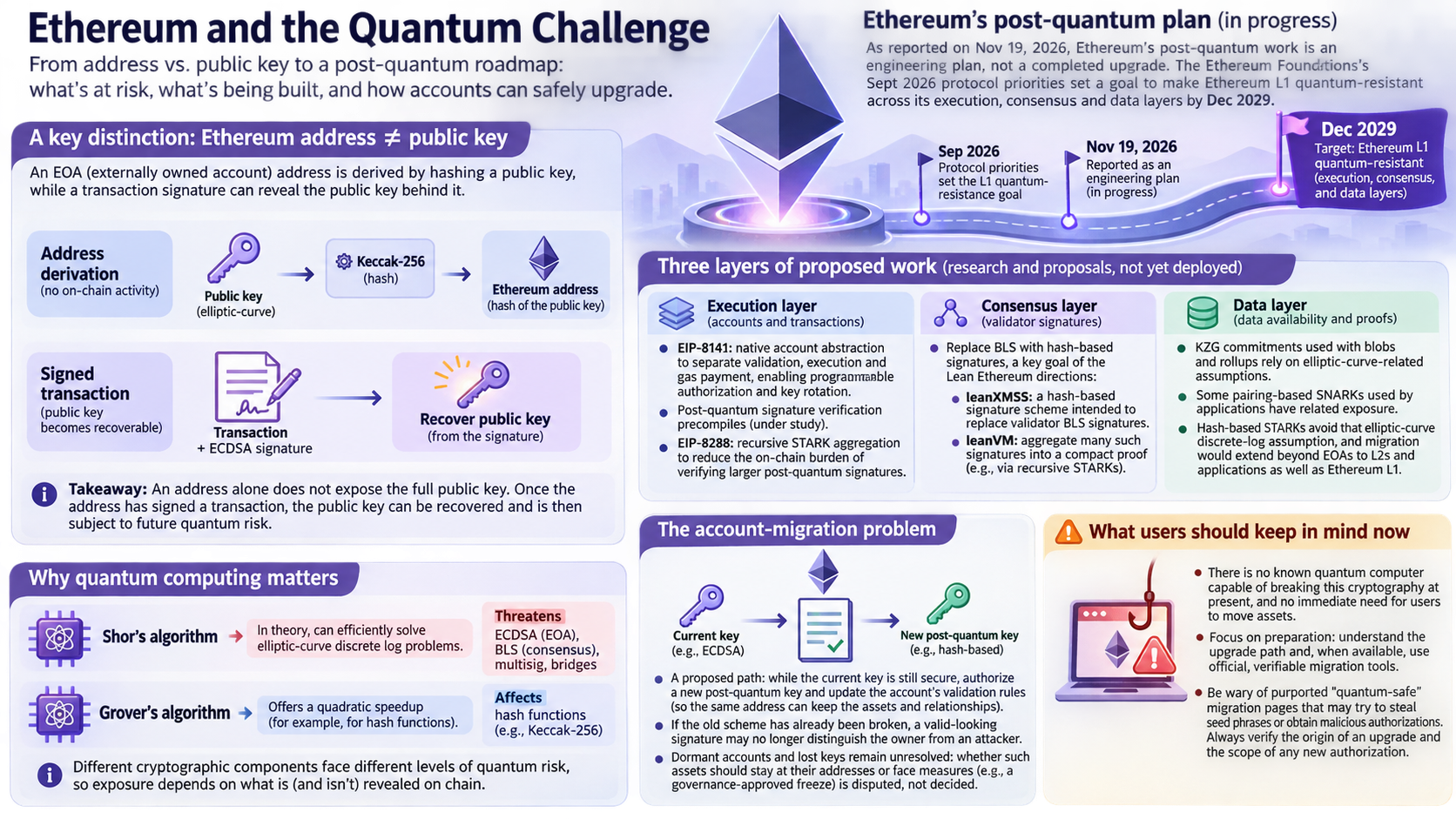
An Ethereum address is not the same thing as a public key. That distinction matters when assessing quantum risk: a standard externally owned account (EOA) address is derived by hashing a public key, while a transaction signature can reveal the public key behind it.
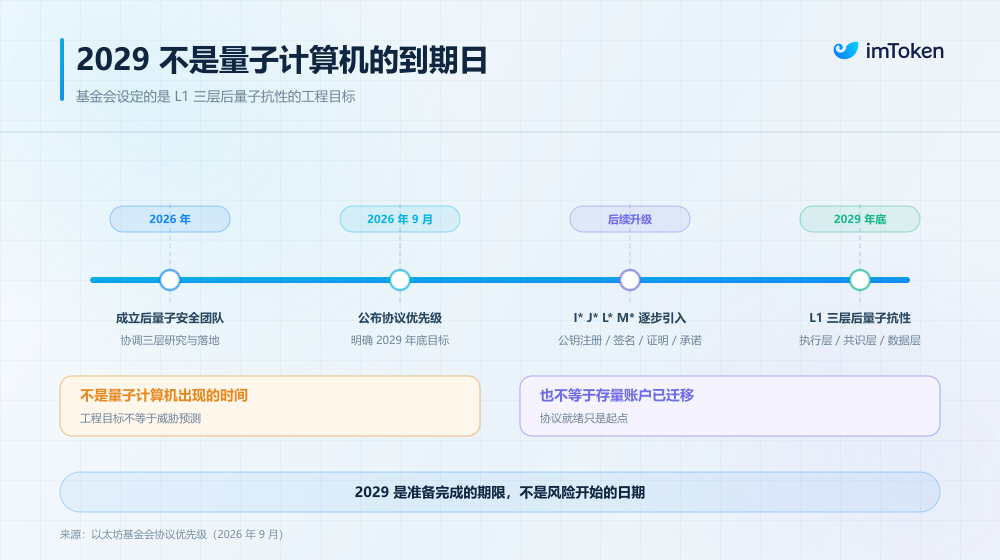
As reported on November 19, 2026, Ethereum’s post-quantum work was an engineering plan, not a completed security upgrade. The Ethereum Foundation’s protocol priorities published that September set a goal of making Ethereum L1 resistant to quantum attacks across its execution, consensus and data layers by December 2029.
What the existing records expose
EOAs use ECDSA signatures to authorize transactions. If a wallet has never sent an on-chain transaction or disclosed an off-chain signature, its address alone does not expose its full public key. Once it has signed a transaction, the public signature can be used to recover that key. A sufficiently capable fault-tolerant quantum computer running Shor’s algorithm could, in theory, derive the corresponding private key and forge signatures.
The risk is not limited to user wallets. Ethereum’s proof-of-stake consensus uses BLS validator signatures, and control keys for multisignature arrangements and bridges could face similar concerns. The source reported that no quantum computer capable of breaking this cryptography existed at the time. It did not present an immediate need for users to move assets.
Hash functions such as Keccak-256 face a different quantum-security question. Grover’s algorithm offers a quadratic speedup, rather than the kind of polynomial-time attack Shor’s algorithm poses to the relevant elliptic-curve assumptions. An address with no exposed public key therefore has a different exposure profile from one that has signed a transaction; neither observation is, by itself, a complete account-security assessment.
Three layers of proposed work
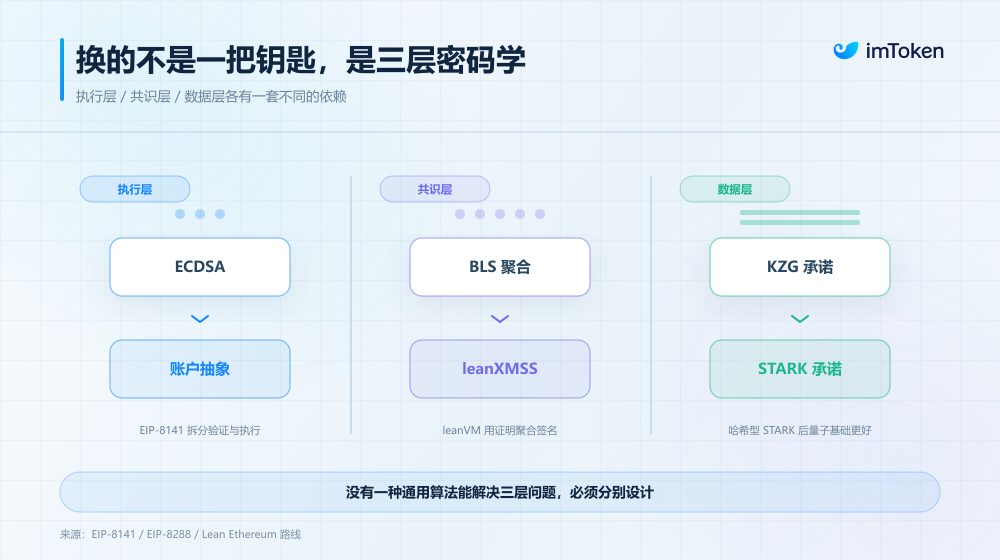
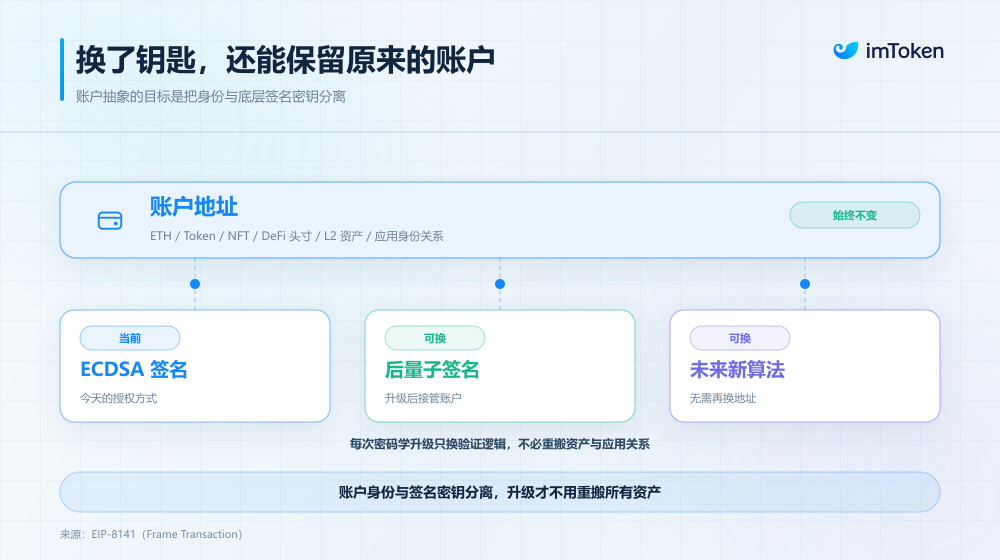
At the execution layer, the issue is how an account could change its authorization method without forcing every asset and application relationship to move to a new address. EIP-8141, discussed as a native account-abstraction proposal, would separate transaction validation, execution and gas payment to make programmable authorization and key rotation possible. Ethereum is also studying precompiles for post-quantum signature verification. EIP-8288 proposes recursive STARK aggregation to reduce the on-chain burden of verifying larger post-quantum signatures. These are proposals and research directions, not capabilities the source says were already deployed.
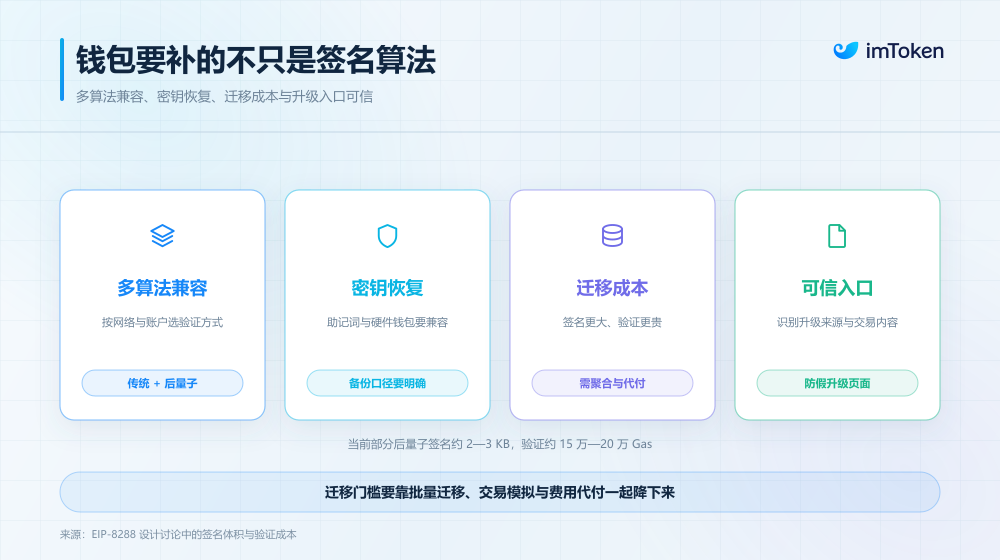
At the consensus layer, replacing BLS signatures creates a size and processing challenge: validators’ signatures must be propagated and verified across the network. The Lean Ethereum directions described in the report include leanXMSS, a hash-based signature approach intended to replace validator BLS signatures, and leanVM, intended to aggregate many such signatures into a compact proof.
At the data layer, KZG commitments used with blobs and rollup data availability depend on elliptic-curve-related assumptions. Some pairing-based SNARKs used by applications have related exposure. Hash-based STARKs avoid that particular elliptic-curve discrete-log assumption. Migration would consequently extend beyond EOA signatures and could affect L2s and applications as well as Ethereum L1.
The account-migration problem
A new signing algorithm does not automatically transfer control of an existing account. A proposed path is for a user, while their current key remains secure, to authorize a new post-quantum key and update the account’s validation rules. If the old signature scheme has already been broken, a valid-looking signature alone may no longer distinguish the owner from an attacker.
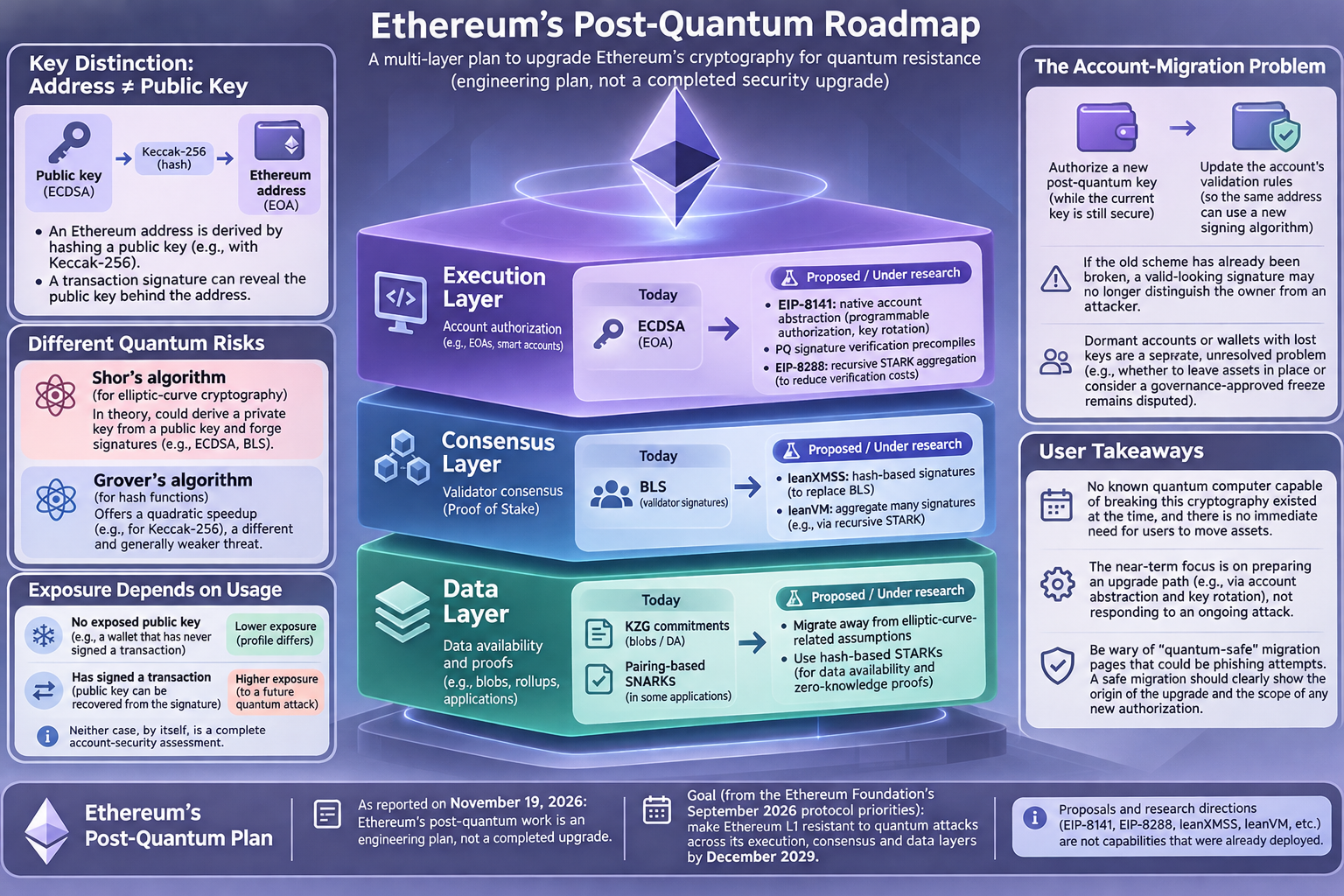
Dormant accounts and wallets whose keys are lost present a separate unresolved problem: their owners may be unable to authorize any upgrade. Whether such assets should remain at their addresses or face measures such as a governance-approved freeze was described as disputed, not decided.
For users, the near-term distinction is between preparing an upgrade path and responding to an immediate attack. The report warned that purported “quantum-safe” migration pages could instead solicit seed phrases or malicious authorizations. A safe migration process would need to make both the origin of an upgrade and the scope of any new authorization clear.