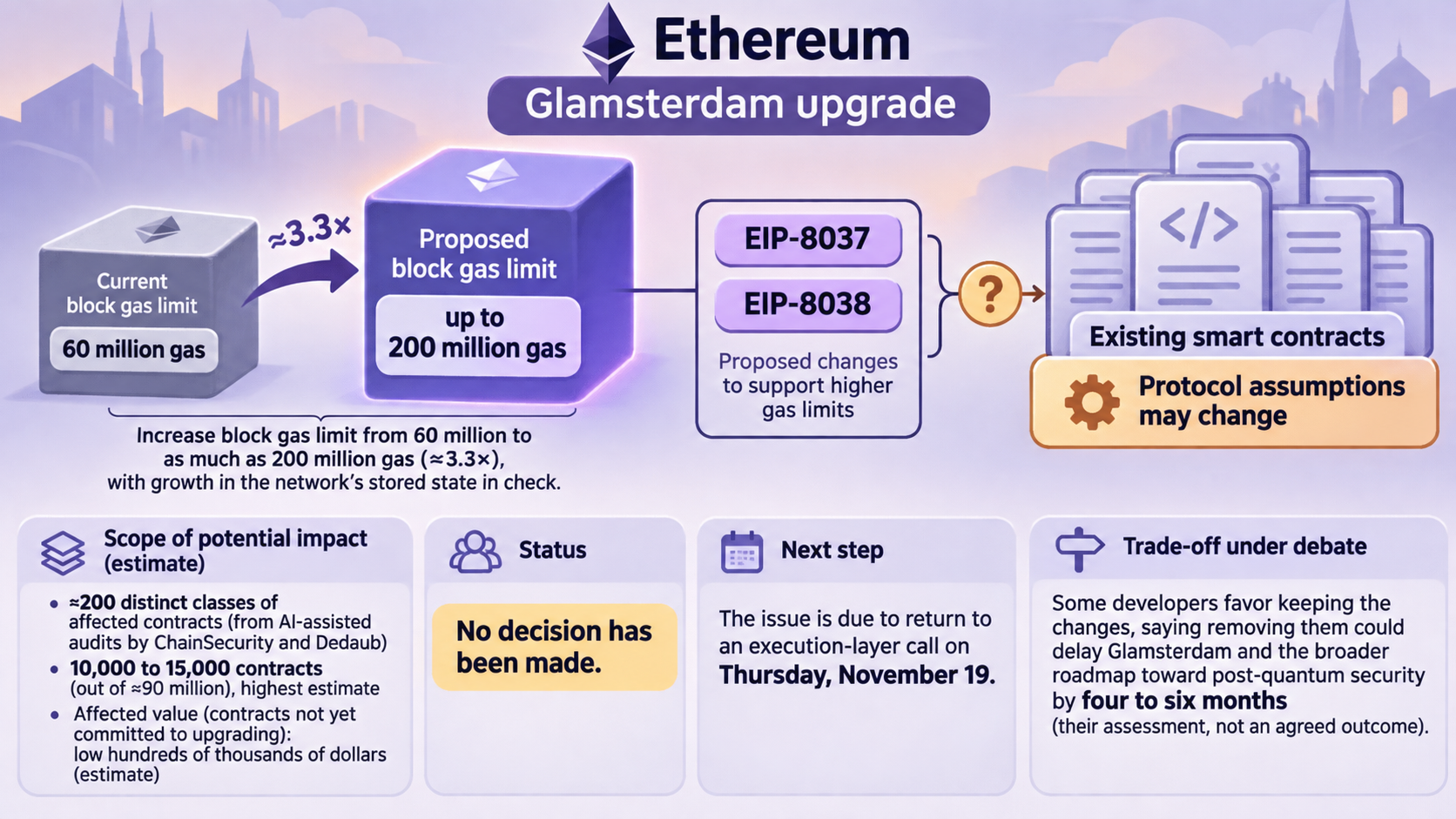
As reported on November 18, 2026, Ethereum developers were weighing whether two proposed changes for the Glamsterdam upgrade could disrupt existing smart contracts. No decision had been made; the issue was due to return to an execution-layer call on Thursday, November 19.
EIP-8037 and EIP-8038 are intended to support an increase in Ethereum’s block gas limit from 60 million to as much as 200 million gas—about 3.3 times the current figure—while keeping growth in the network’s stored state in check. Developers said the changes could lower costs for most users. The compatibility concern is that they would alter protocol assumptions on which some contracts rely.
ChainSecurity and Dedaub presented findings from AI-assisted audits. Together, their searches identified roughly 200 distinct classes of affected contracts, most associated with higher gas costs rather than the proposals’ new mechanics. Ethereum Foundation developer Marius van der Wijden put the highest estimate at 10,000 to 15,000 contracts, out of roughly 90 million Ethereum contracts. That is an estimate of contracts, not a count of apps. He loosely estimated the affected value among contracts not yet committed to upgrading at the low hundreds of thousands of dollars.
Van der Wijden said planned public outreach had slipped amid Ethereum Foundation reorganizations and budget cuts, and accepted a share of responsibility. Juicebox developer Jango argued that changing assumptions relied on by deployed contracts would undermine composability and confidence in immutable protocols. A Uniswap developer urged reconsideration of EIP-8037.
The Ethereum Foundation had already delayed Glamsterdam’s testnet fork over the gas-related security issues. Some developers nevertheless favored retaining the changes, arguing that removing them could delay Glamsterdam and the broader roadmap toward post-quantum security by four to six months. That was their assessment of the trade-off, not an agreed outcome.