
What allows a depositor and a stablecoin holder to exchange different forms of the same currency at face value? Bank of Japan Executive Director Kazushige Kamiyama put that question at the center of his November 27, 2026, keynote at an International Monetary Fund seminar in Tokyo. He called for oversight of stablecoin reserves and redemption arrangements, along with carefully designed links to central bank money. His remarks were a policy recommendation, not a new rule.
Kamiyama described the principle at stake as the singleness of money. Banks settle obligations to one another using central bank reserves, a common settlement asset that helps sustain confidence in deposits issued by different banks. A privately issued stablecoin, by contrast, depends on the assets backing it and the arrangements under which holders can redeem it. Kamiyama expects stablecoins and tokenized deposits to coexist, but said their ability to work together depends on those safeguards and on reliable settlement infrastructure.
The remarks followed a November 26 agreement by China, Japan, South Korea and ASEAN members to advance discussions on cross-border payments. Topics included stablecoin regulation, links between payment systems and the implications of tokenization for monetary sovereignty.
Faster settlement can still leave liquidity on the wrong platform
Tokenized assets can trade around the clock, but conventional payment systems operate on different schedules. Institutions may therefore need to hold more cash and collateral. Even an institution with enough funds overall may be unable to move them between blockchain platforms in time to meet an obligation. “Faster settlement does not automatically mean more efficient liquidity management,” Kamiyama said.
Automation poses a separate risk. When a preset condition is met, a smart contract can demand more collateral or liquidate a position. Kamiyama warned that during a market disruption, such actions could intensify price moves and transmit stress across connected institutions and markets.
He called for compatible technical standards and operating rules that specify which responsibilities belong to financial institutions, platform operators and third-party providers. He also warned that artificial intelligence could make security flaws easier to find and exploit, and said legal ownership of tokenized assets and the enforceability of blockchain transactions need clarification.
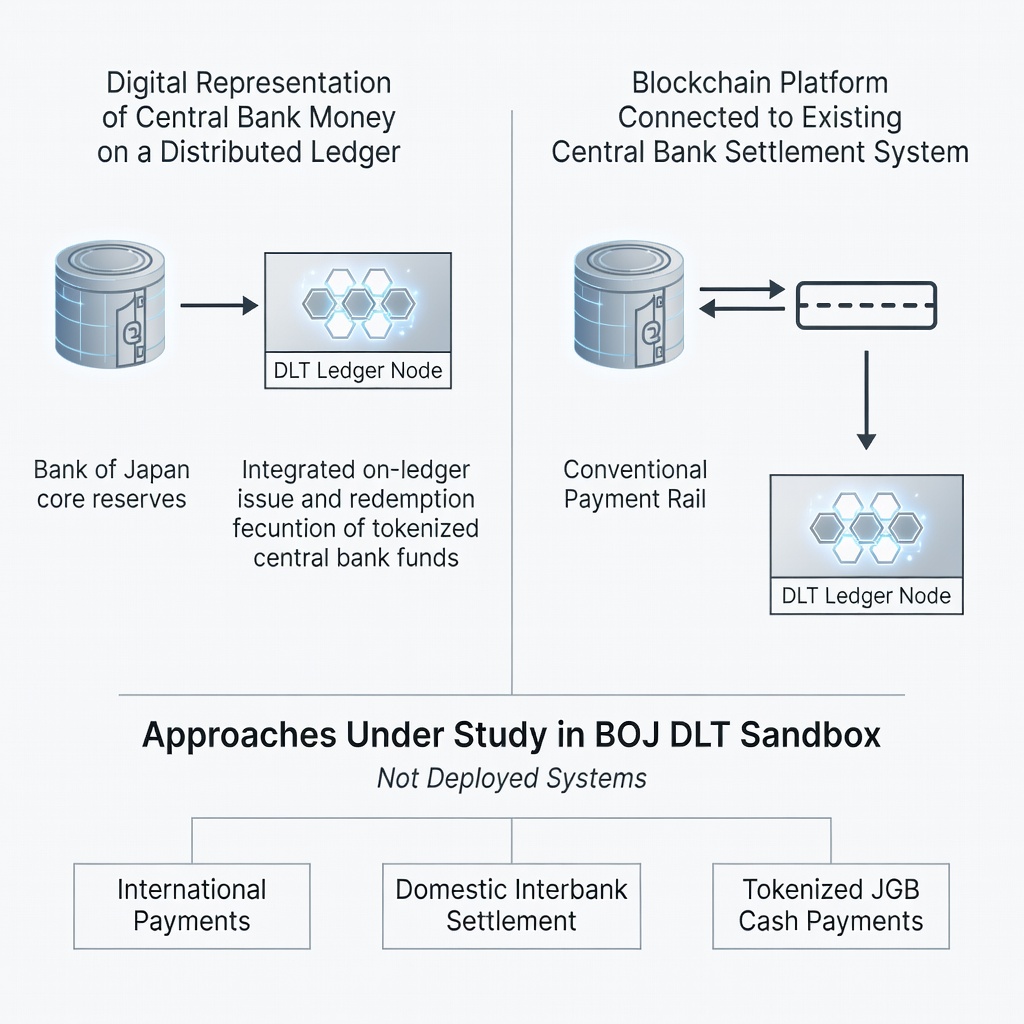
Two ways to connect central bank money to a ledger
The Bank of Japan’s distributed ledger technology sandbox is examining whether representing central bank money digitally offers practical advantages over linking blockchain platforms to existing settlement systems. Working with institutions that hold accounts at the central bank, it is studying three uses: international payments, domestic interbank settlement and the cash payment in a trade of tokenized Japanese government bonds. At a May 29 meeting on central bank digital currencies, Kamiyama said the findings would inform improvements to BOJ-NET, Japan’s existing interbank settlement infrastructure.
Private initiatives are examining related uses. On November 25, SBI Holdings, Sumitomo Mitsui Financial Group and the Solana Foundation completed agreements establishing SBI Solana Global, a venture focused on blockchain payments, asset tokenization and investment management. In October, BlackRock agreed with SBI Holdings and Startale Group to examine how tokenized money market funds could connect to JPYSC, a yen-denominated stablecoin.
What Project Agorá measured
The Bank of Japan also participates in Project Agorá, a Bank for International Settlements (BIS) initiative involving eight central banks and more than 40 financial institutions. It examines whether representing commercial bank deposits and central bank reserves on shared infrastructure can simplify international wholesale payments.
In controlled tests in July 2026, 28 institutions completed real-value transactions totaling approximately CHF 800,000, according to BIS data. The tests covered 17 scenarios across six currencies, including the yen, US dollar, euro and South Korean won. Payments took approximately 80 seconds on average from initiation to settlement, a measurement from the test rather than a benchmark for live payment systems.
Yen-denominated transactions totaled approximately ¥86 million. Japanese participants included Mizuho Bank, MUFG Bank and Sumitomo Mitsui Banking Corporation. Participating central banks issued and redeemed tokenized reserves through arrangements linked to their existing settlement infrastructure.