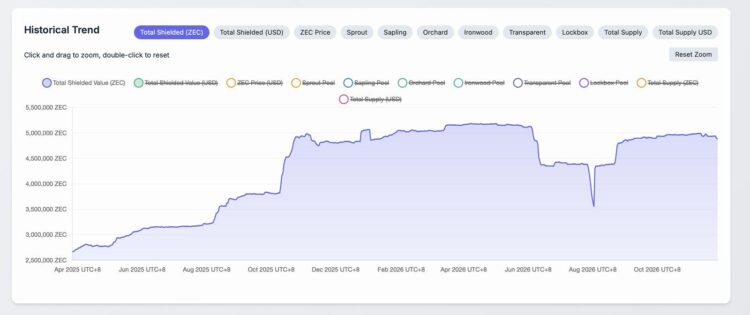
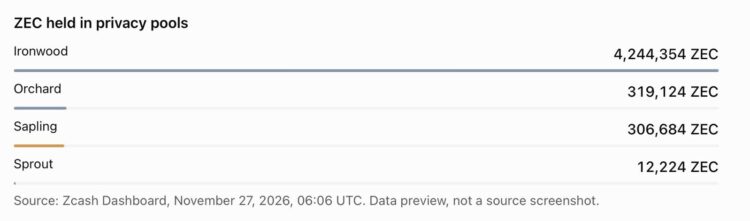
The Zcash Dashboard showed about 306,684 ZEC in Sapling at 06:06 UTC on November 27, 2026. A day earlier, Zcash development team Zakura had estimated that the shielded pool held roughly 400,000 ZEC when it called for accelerating Sapling’s retirement. The dashboard balance was below that rounded estimate, but the difference does not establish that users moved funds in response to the proposal.
Zakura proposed blocking new deposits into Sapling and encouraging users to move their funds to Ironwood, a newer shielded pool. The proposal did not itself close Sapling to deposits. Its immediate premise was speculation about mathematical advances at AI laboratories that might undermine assumptions behind Sapling’s cryptographic proofs. Those advances remain unverified; Zakura did not report a successful quantum attack. The team said further emergency measures could be considered if credible evidence of a threat emerged.
What a move to Ironwood would change
Zcash shielded pools let users transact without publishing certain transaction details. Moving funds from Sapling to Ironwood would reduce reliance on the older proof system. Ironwood includes features intended to support a future recovery mechanism, but they do not make Zcash quantum-resistant. The proposal follows the NU7 network upgrade, which improved transaction speed and continued Zcash’s transition away from older infrastructure.
Shielded Labs is pursuing post-quantum privacy technology separately through its Epoch project. In its first technical update on November 25, the team identified proof size as a constraint: proofs that require more data to transmit and verify can affect transaction capacity, verification costs and storage. Shielded Labs was evaluating two approaches and expected to choose one by the end of January 2027 if research proceeded as planned.
What Bitcoin’s exposure figures count
Bitcoin’s ledger allows a different measurement: the amount of BTC associated with public keys or spending scripts already visible on-chain. Bitcoin verifies spending authority through a signature made with a private key. Deriving that key from its public counterpart is impractical with conventional methods. A sufficiently powerful quantum computer running an algorithm such as the one mathematician Peter Shor introduced in 1994 could change that. A signature made with a recovered key could pass verification even if the owner had not authorized the transfer.
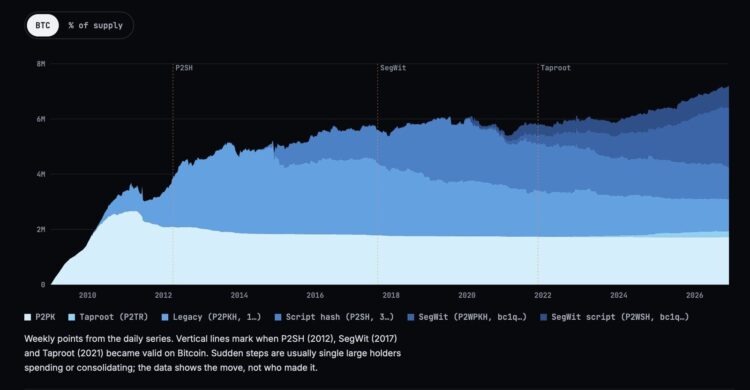
In a November 25 snapshot, The Quantum Ledger classified approximately 7.23 million BTC, or 35.9% of issued supply, as potentially exposed under its methodology. It divided the total into two groups:
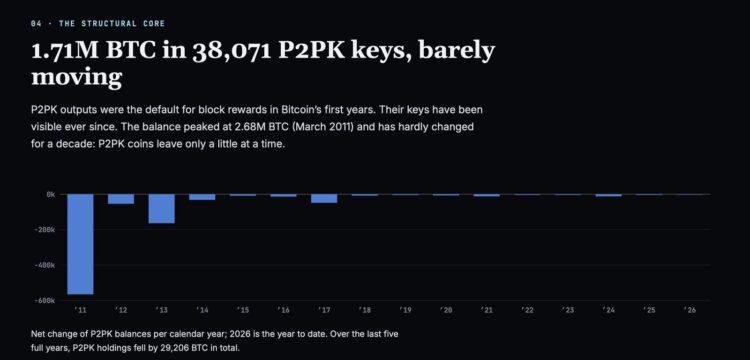
- 1.94 million BTC was exposed by the design of the transaction output itself. Some early Bitcoin outputs disclosed a public key directly.
- 5.29 million BTC was associated with addresses for which relevant spending information had already been revealed.
Glassnode identified 6.04 million BTC in May 2026 using its own classification framework. The estimates are not directly comparable measures of growth, and neither is a tally of thefts or a forecast of losses. Owners who retain their keys could move coins if suitable protection becomes available. Coins whose owners have lost their keys are harder to protect: restricting future spending could prevent theft, but such a restriction could also bar legitimate owners of old outputs from accessing their funds.
The timeline for changing signatures
Bitcoin proposal BIP-360 would introduce an output format intended to reduce certain kinds of public-key exposure. A separate draft, BIP-361, explores phasing out vulnerable signature schemes once alternatives are available. Neither is an activated Bitcoin upgrade. On Ethereum, migration would reach beyond individual wallets to validator signatures, staking arrangements and institutional custody.
The US National Institute of Standards and Technology has developed post-quantum cryptographic standards, but adopting new protections across a network is a separate engineering task. According to Coinbase Institute research, a quantum computer capable of breaking widely used cryptocurrency signatures does not yet exist, and there is no reliable date for one. The institute noted that upgrading blockchains, wallets and custody systems could itself take years. For Sapling, the November 27 balance measures one part of that operational challenge: how much ZEC remained in the older pool, not whether its cryptography had failed.