Ethereum mainnet and Base led growth in tokenized stock deposits in decentralized finance (DeFi) over the seven-day period reported on November 24, 2026. Ethereum added $3.4 million and Base added $2.0 million. Those figures are increases in total value locked (TVL), the dollar value of assets held in DeFi protocols, rather than the total balance on either network.
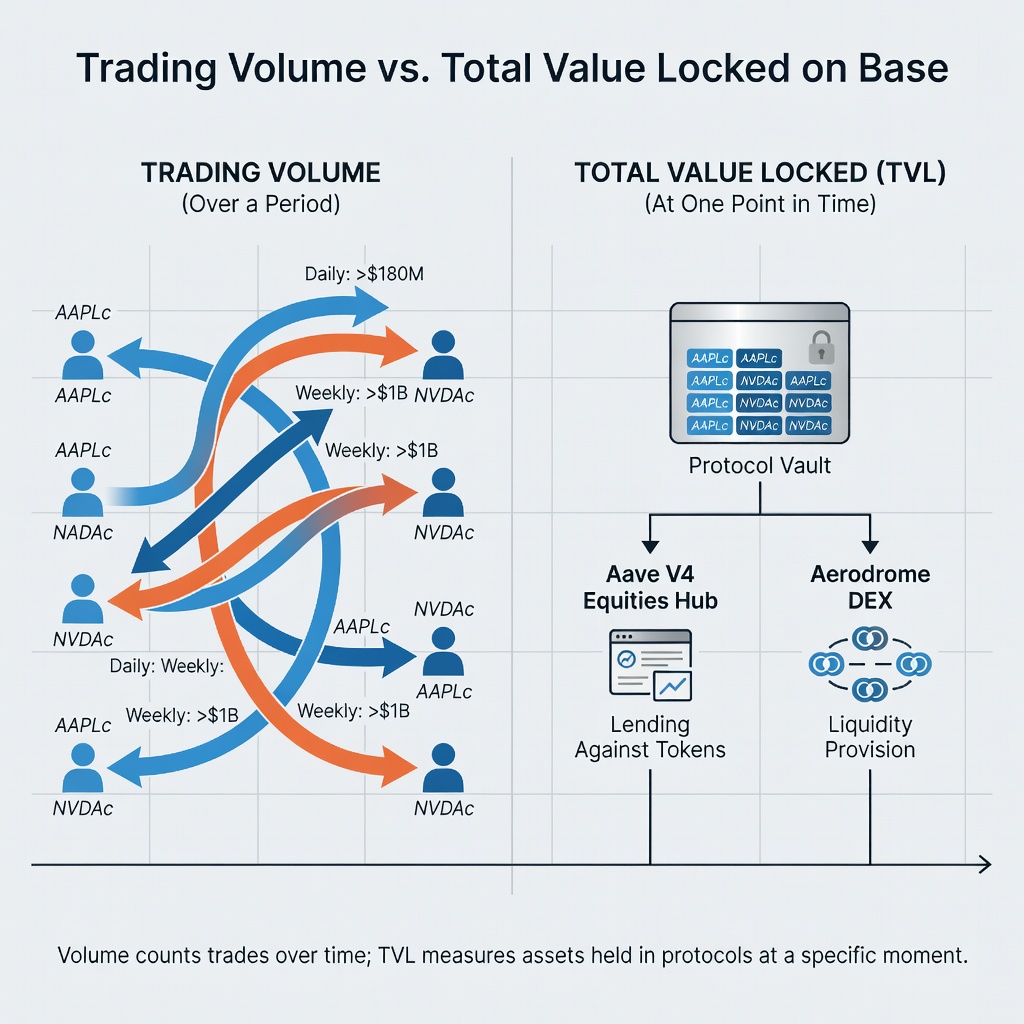
Trading volume and deposits measure different things
Coinbase launched its tokenized stock product on Base, the layer-2 network it incubated, on August 24, 2026. By fall, the lineup had reached about 250 listings, including AAPLc and NVDAc, tokenized versions of Apple and Nvidia shares. Daily trading volume in tokenized stocks on Base had exceeded $180 million, and weekly volume had reached or surpassed $1 billion. Volume counts the value of trades during a period; it does not show how much remains deposited in a protocol.
On Base, Aave V4’s Equities Hub supports lending against tokenized stocks, while liquidity providers can deposit the tokens on decentralized exchanges such as Aerodrome to facilitate trades. Stock-backed lending also exists at traditional brokerages. The difference on-chain is that smart contracts administer loan terms around the clock. If a loan faces liquidation on a Sunday, the protocol must value the collateral while the underlying stock exchange is closed.
How much tokenized stock is held in DeFi?
Across the sector, tokenized stock deposits in DeFi rose from an estimated $15 million–$22 million at the start of 2026 to more than $300 million by late October. The November report described that as roughly 18- to 20-fold growth.
The broader tokenized equities market had an estimated capitalization of $3 billion–$3.8 billion by late 2026. The figures suggest that only a fraction of tokenized stock value was deployed in DeFi. Because the deposit figure and market estimate refer to different observation dates, they do not establish a precise share or show where the remaining tokens were held.