
Figures in this account are those reported on November 23, 2026, in coverage published November 24, 2026. They describe that window only, not later chain activity.
The ledger question is specific. Over the 10 days leading up to November 23, how often did Litecoin record transfers on Mimblewimble Extension Blocks (MWEB), and did that change the amount of LTC sitting in the extension-block pool?
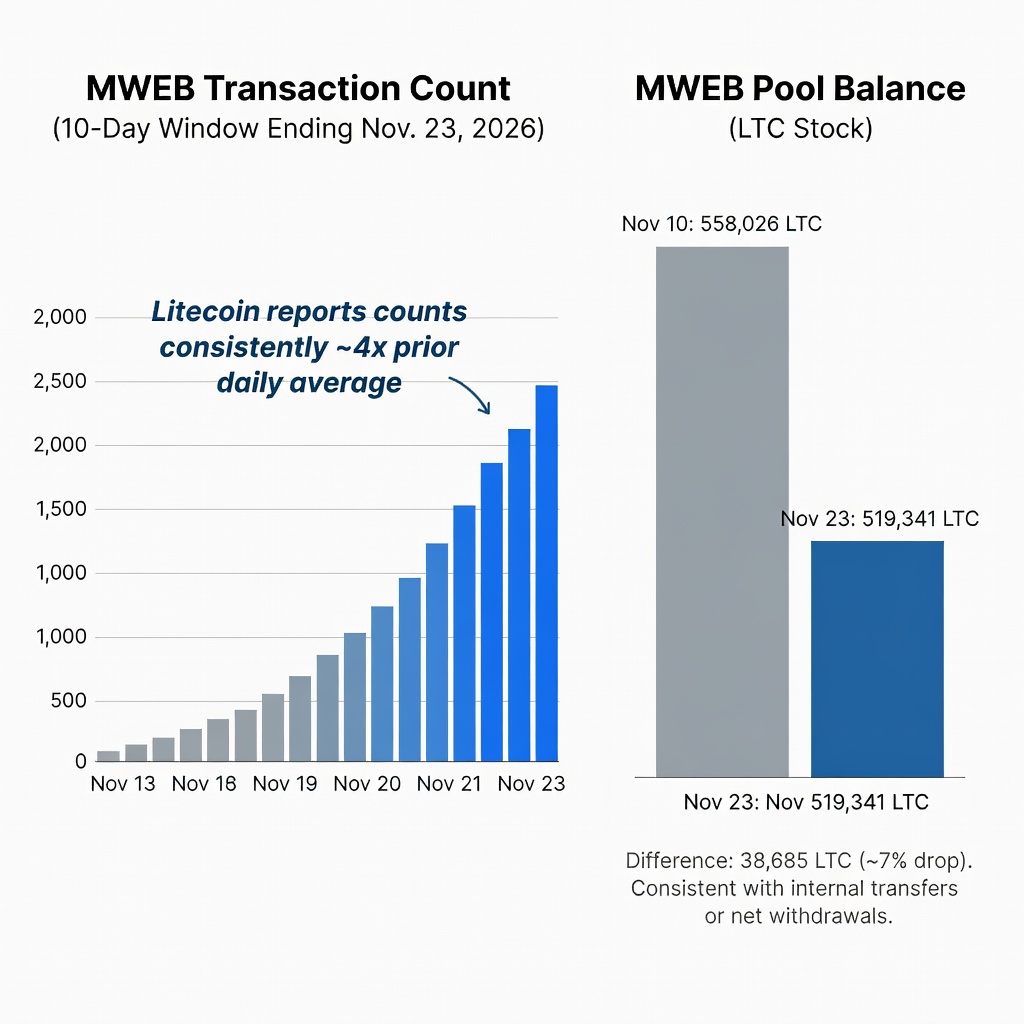
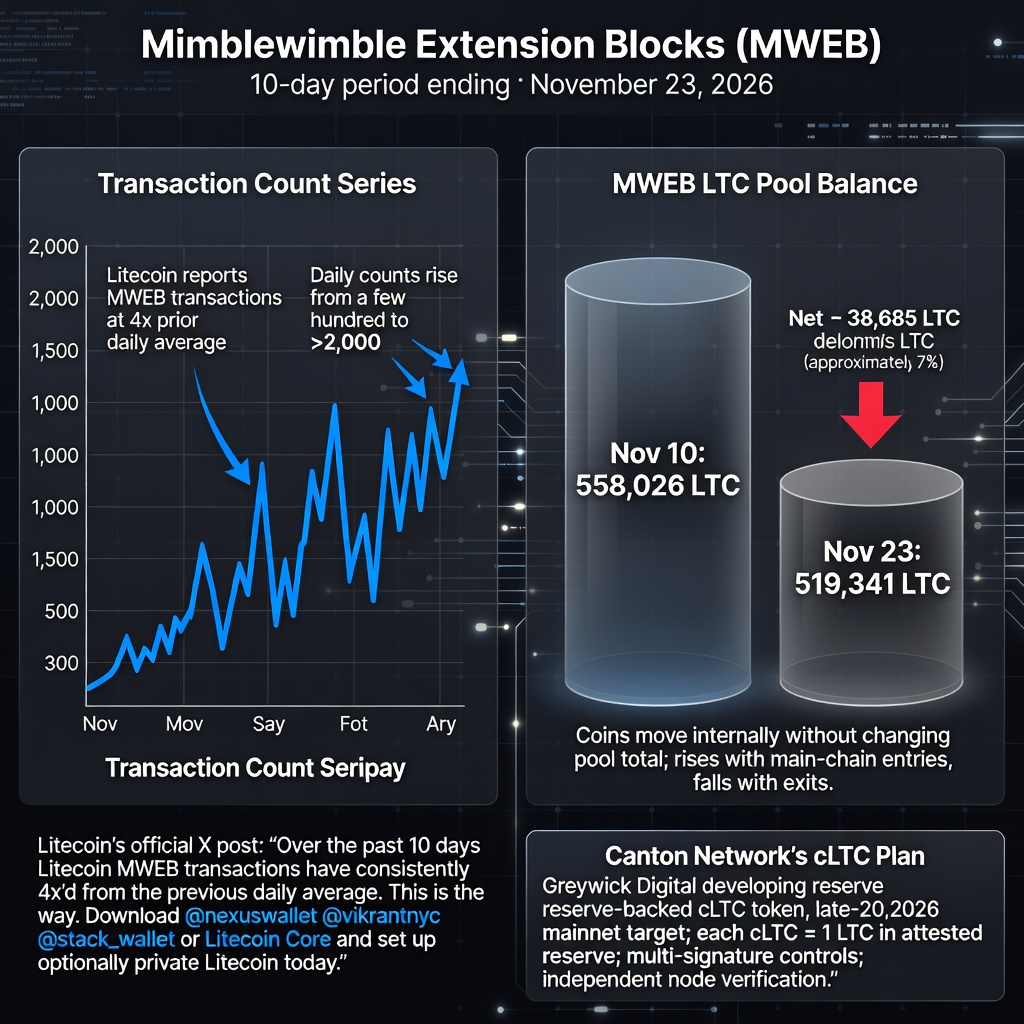
Litecoin’s official X account said on November 23 that MWEB transactions had consistently run at four times the previous daily average over those 10 days. The chart it shared showed daily counts rising from a few hundred on many earlier days to more than 2,000 on several days in November. The same post urged people to set up optional privacy with the accounts it tagged—@nexuswallet, @vikrantnyc, and @stack_wallet—or with Litecoin Core. That 4x figure is the project account’s reading of its chart. It is a count of recorded transfers, not a list of who sent them.
What the two fields measure
MWEB went live in May 2022 as an optional extension of Litecoin’s ledger, not as a separate coin. Users can move LTC from the main chain into the extension blocks, where transfer amounts are hidden from public view, and later move coins back. A payment made through MWEB uses the same LTC that circulates on the main chain.
Two readings cover different objects, on overlapping but not identical dates, and they moved in opposite directions.
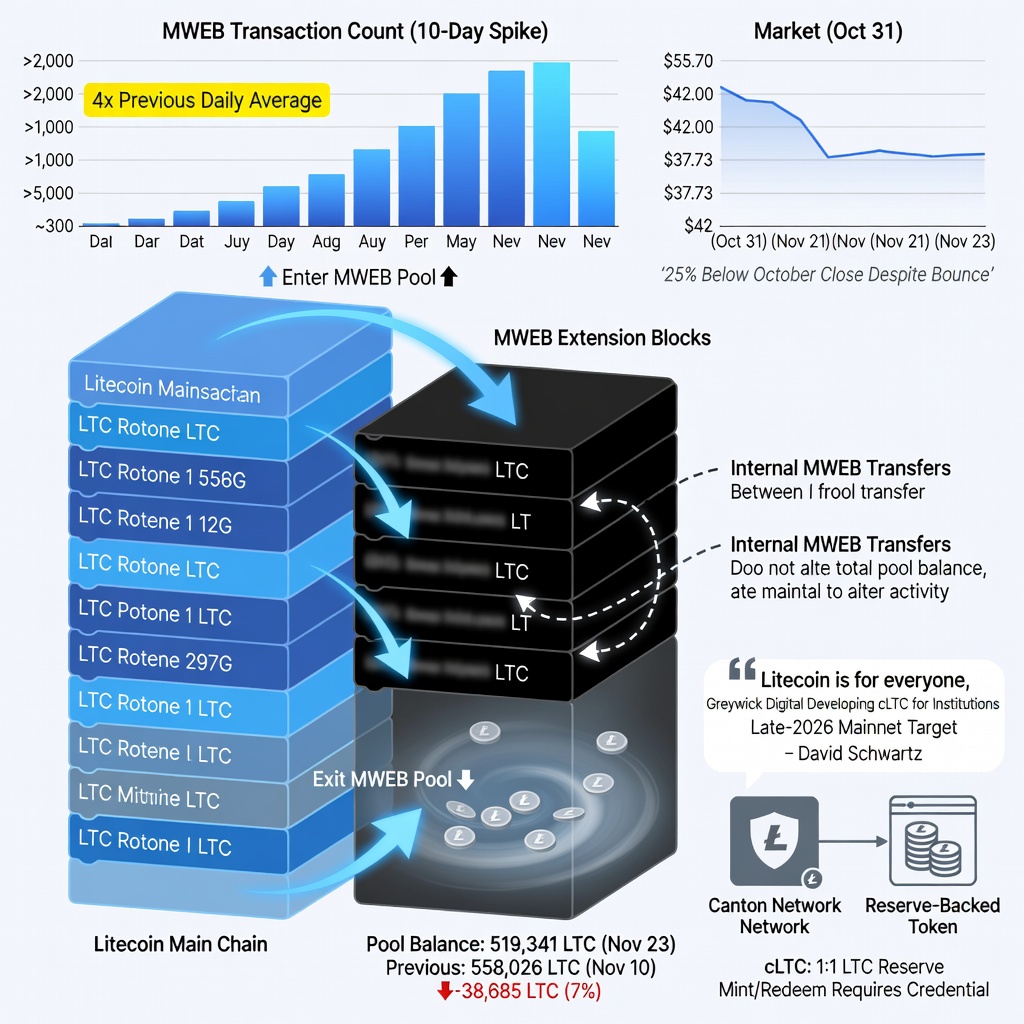
Transaction count. This is how often the extension blocks recorded a transfer. Litecoin said that count stayed near four times the prior daily average across the 10-day stretch. An explorer tally gives every transfer the same weight. One wallet or one service can generate many of those records, so the series measures how often the feature was used. It does not measure distinct people, and the published chart summary does not give the LTC amount of each payment.
Pool balance. This is the stock of LTC inside MWEB. SoChain recorded 519,341 LTC on November 23, compared with 558,026 LTC on November 10. The difference was 38,685 LTC, about 7 percent lower. Coins can move between users already inside MWEB without changing that total. The pool rises when coins enter from the main chain and falls when coins leave. A higher transfer count alongside a smaller pool is consistent with internal movement, with net withdrawals, or with both. These two series do not name the addresses behind the spike, and an address in the tally is not the same thing as an identified person.
Market prints, kept apart from the count
CoinGlass showed LTC trading near $42 on November 23, after a November 21 low of $37.73. Litecoin had ended October at $55.70, so the November 23 level was about 25 percent below that close despite the bounce. Those are observed prices. They do not show that the MWEB count caused the move.
cLTC was still a Canton plan
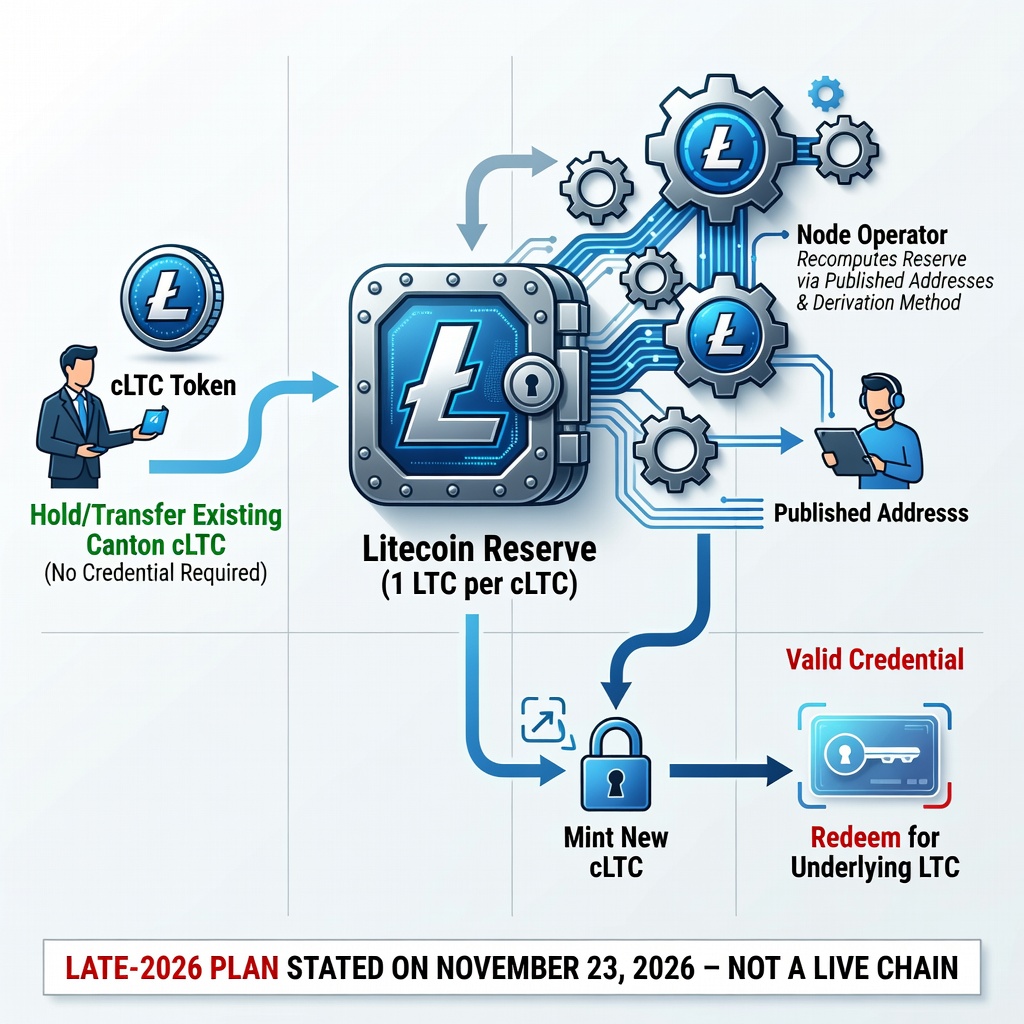
On November 23, 2026, Canton Network said Greywick Digital was developing cLTC, a reserve-backed Litecoin token, with a late-2026 mainnet target. The Litecoin Foundation has endorsed the project. At the time of this reporting the target was a stated launch plan, not an activated change on Litecoin or a live Canton token.
Under Greywick’s terms, each cLTC issued on Canton would correspond to one LTC in reserve on Litecoin. Greywick says moving that reserve would require multiple signatures, and that independent checks would use published Litecoin addresses. It also says it will publish how those addresses are derived, so someone running a Litecoin node can calculate the reserve balance independently. On that design, transaction details on Canton would be visible to the parties involved, while anyone could check the Litecoin backing.
The issuer separates two operations. Canton participants could hold and transfer a cLTC token that already exists on Canton without a bridge credential. Minting new tokens, or redeeming them for the underlying LTC, would require a valid credential. That split is what the published terms say; it is not evidence that minting was already open.
David Schwartz, the Litecoin Foundation’s director of strategic partnerships, said in a statement published by Greywick: “Litecoin is for everyone.” He said the Canton project could put Litecoin in front of institutions that might otherwise have no reason to use existing routes to access it.
Greywick says it plans to start with a cap on the reserve and raise that cap after periods of smooth operation. Its terms also say the amount of cLTC in circulation would be limited by the independently attested reserve. The company is pitching cLTC to trading desks, funds, and treasury companies that want to use LTC as collateral without selling it. Those are stated plans, not reported figures for cLTC already issued.
Canton has also drawn traditional market-infrastructure proposals. In April, S&P Dow Jones Indices and Kaiko unveiled plans to bring the iBoxx Treasury index to the network, with licensing terms and access controls built into a smart contract. That was a proposal as described, not a claim that the index was already live on the network.
Where venues already refuse MWEB transfers
Making privacy optional left exchanges free to decide which transfers they will book. In June 2022, after the upgrade, several South Korean exchanges moved to delist LTC. Upbit cited South Korean rules on anonymous transactions in its decision to end support for the asset.
In April 2026, Litecoin reversed 13 blocks after an incident involving MWEB. The Litecoin Foundation said it patched the bug. This reporting confirms the reversal and the foundation’s statement that the bug was patched; it does not include a transaction-level account of the incident.
Other venues have drawn the line at the transfer method. In its June 2022 support notice, Binance said it would reject MWEB deposits and withdrawals and could neither credit nor return deposits sent through the feature, because it could not verify the sender’s address. Thailand’s Bitkub, in a February notice, cited securities-regulator rules and excluded MWEB deposits and withdrawals.
For anyone reading the ledger, that is an operational constraint around the extension blocks. MWEB hides the amount, and Binance said it could not verify a sender address on those deposits. A custody rule that requires that address will not credit the transfer—and, on Binance’s stated policy, will not return it either. That limit is separate from how many MWEB transactions the chain counted in the November 2026 window.