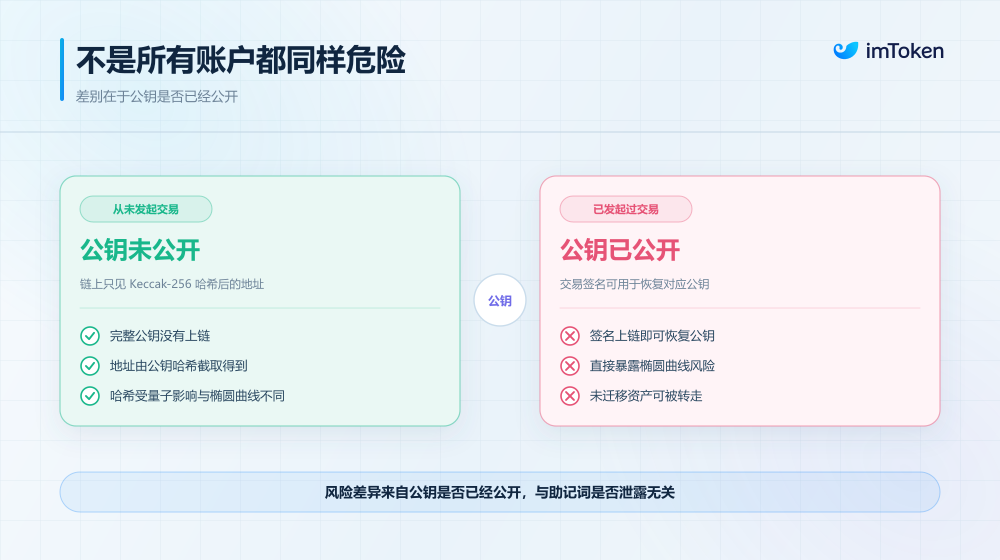
An Ethereum address is not the same thing as a publicly visible key. That distinction matters when assessing quantum-computing risk: an ordinary externally owned account (EOA) address is derived from a hash of its public key, while a transaction signature can allow the full public key to be recovered.
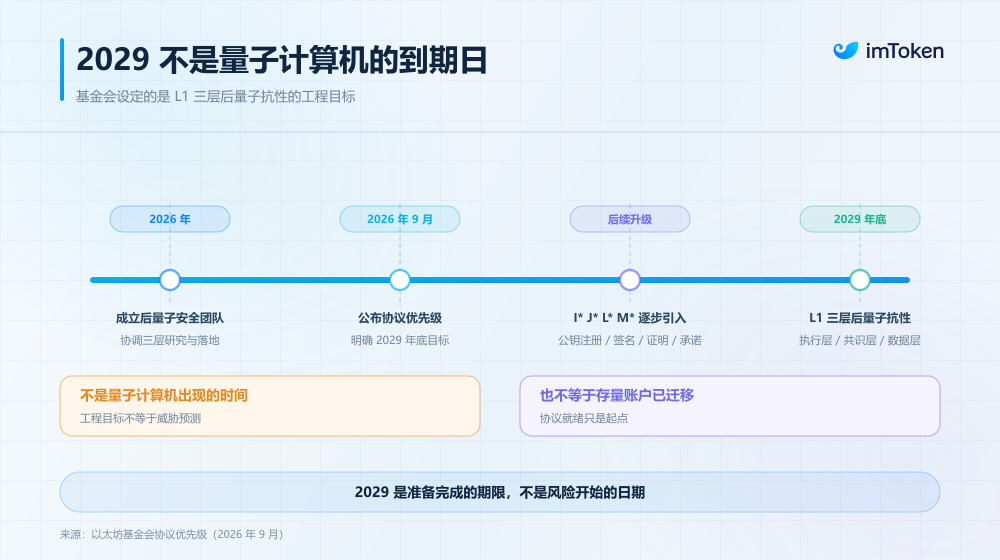
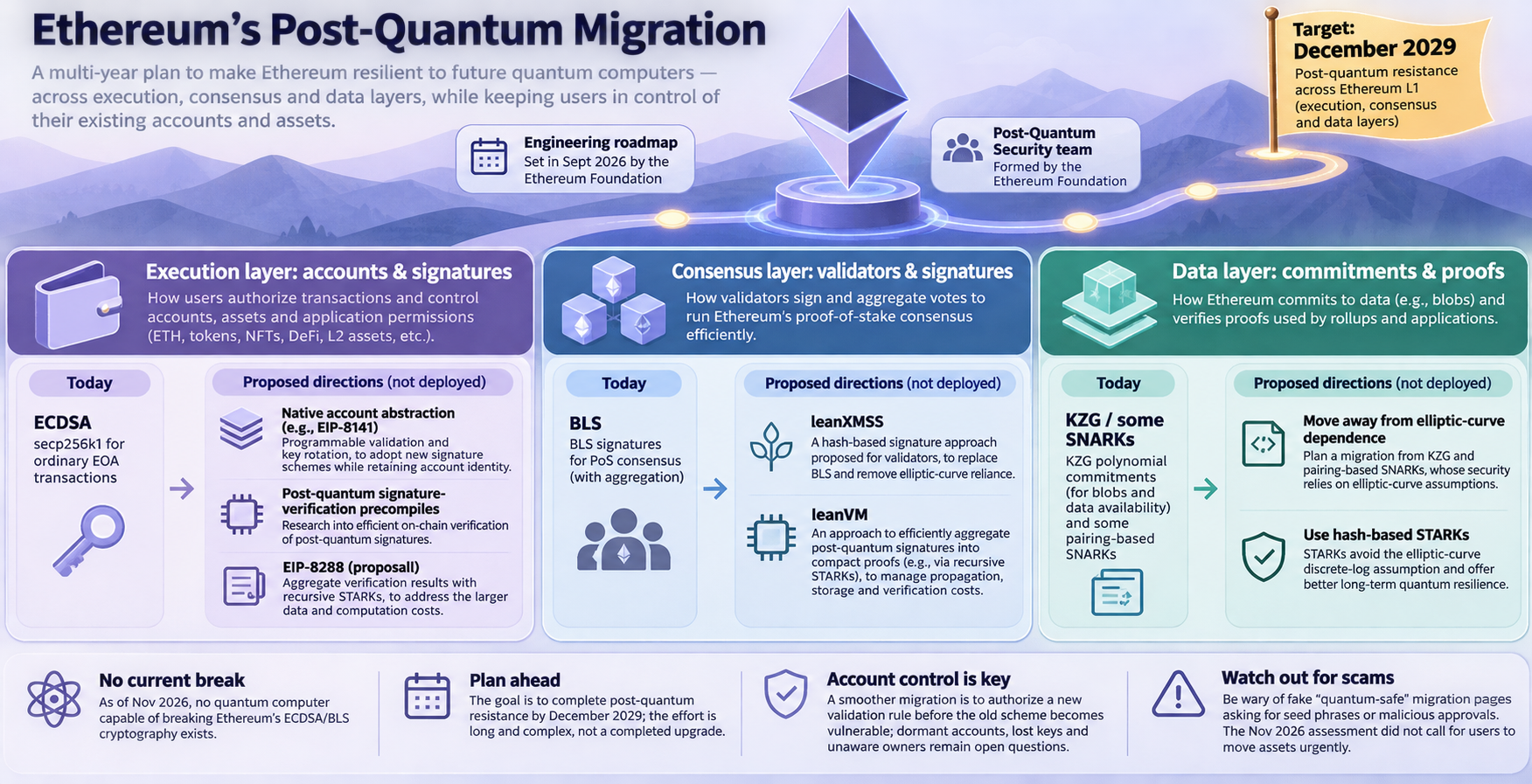
In an article published on 18 November 2026, imToken examined how Ethereum might move to post-quantum cryptography without leaving users unable to control existing accounts and assets. It reported that the Ethereum Foundation had formed a Post-Quantum Security team and that protocol priorities published in September 2026 set a target of December 2029 for post-quantum resistance across Ethereum L1’s execution, consensus and data layers. That is an engineering goal, not a completed upgrade.
What the record exposes—and what it does not
An EOA that has never sent an on-chain transaction or disclosed an off-chain signature may have only its hashed address visible, rather than its full public key. Once the account signs a transaction, the public signature can expose the key needed for the attack imToken describes. The relevant distinction is therefore not simply whether an address holds assets, but whether its public key has been revealed.
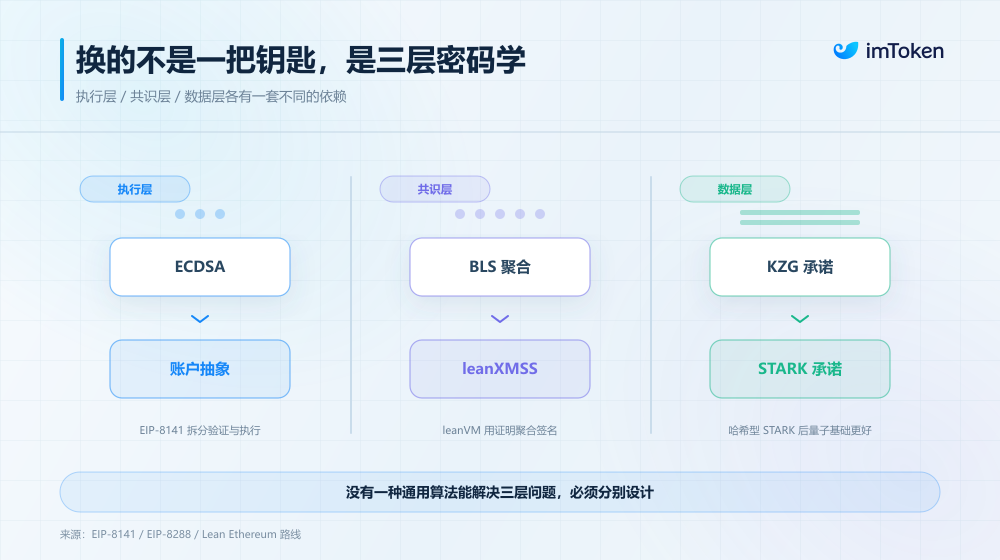
Ethereum currently uses ECDSA signatures for ordinary EOA transactions and BLS signatures in proof-of-stake consensus. A sufficiently capable, fault-tolerant quantum computer running Shor’s algorithm could, in theory, undermine the elliptic-curve assumptions behind those systems. If an attacker could derive a private key from an exposed public key, they could forge signatures without obtaining a seed phrase or compromising wallet software. Validator keys, multisignature administration and cross-chain bridge control keys face related long-term questions.
ImToken contrasted that risk with hash functions such as Keccak-256, which it described as more resilient to quantum attacks. It also stressed that, as of its November 2026 report, no quantum computer capable of breaking the cryptography in question existed. The reason to plan ahead is the length and complexity of a network-wide migration, not an observed compromise of Ethereum accounts.
Three layers, different migration problems
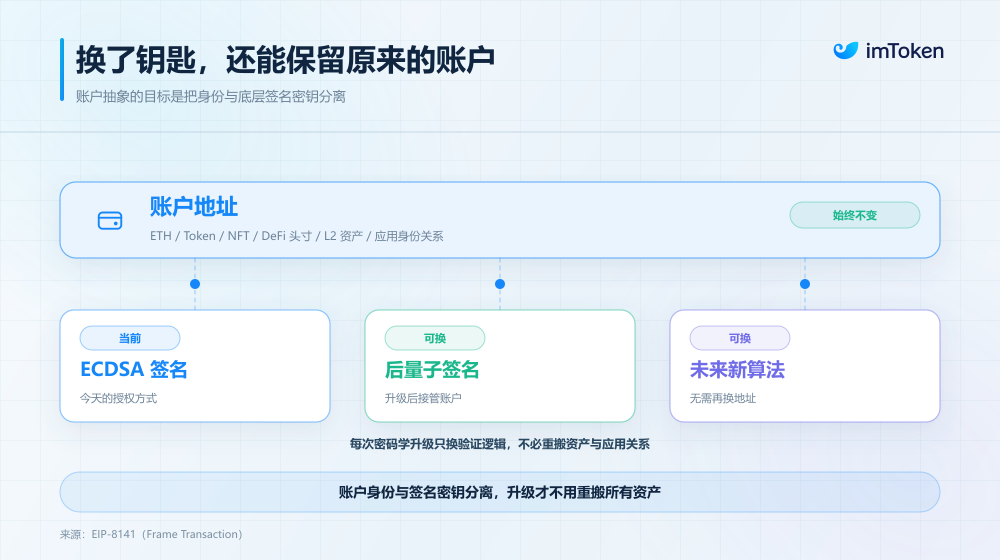
Execution and accounts. A traditional EOA ties authorization to a secp256k1 key verified with ECDSA. Replacing that key by moving to a new address could require users to deal with more than ETH and tokens: NFTs, DeFi positions, L2 assets and application permissions may also be associated with the old address. ImToken described native account abstraction, including EIP-8141, as a proposed route toward programmable validation and key rotation. Such a design could give accounts room to adopt different signature schemes while retaining account identity; the article did not present that outcome as an existing EOA capability. It also discussed research into post-quantum signature-verification precompiles and EIP-8288’s proposal to aggregate verification results with recursive STARKs, addressing the larger data and computation costs of post-quantum signatures.
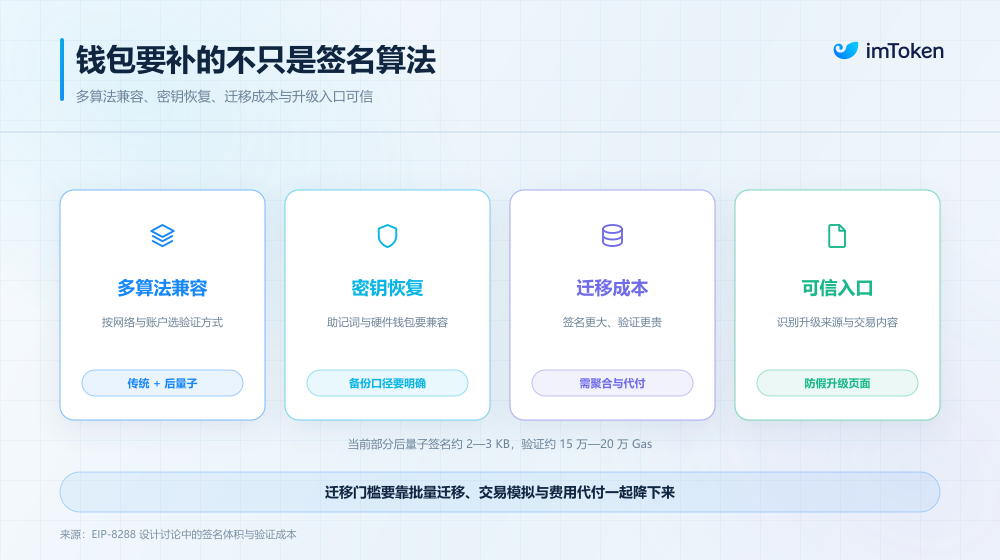
Consensus. Ethereum relies on BLS aggregation to handle validator signatures efficiently. Simply substituting larger post-quantum signatures would raise propagation, storage and verification costs. The Lean Ethereum directions discussed by imToken include leanXMSS, a hash-based signature approach proposed for validators, and leanVM, intended to help aggregate post-quantum signatures into compact proofs. These are proposed technical directions, not a claim that validators have already changed signing systems.
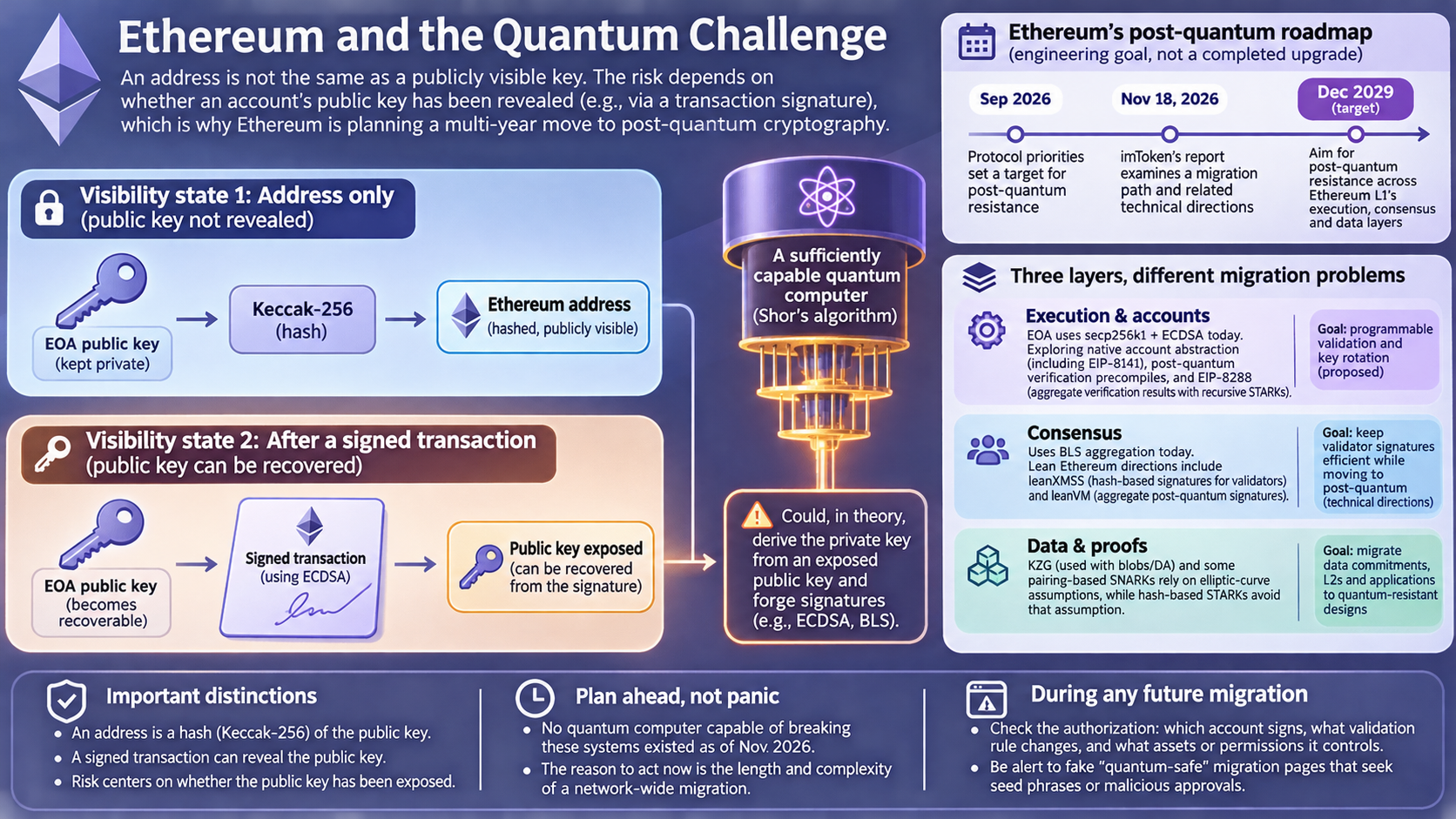
Data and proofs. KZG polynomial commitments used with blobs and rollup data availability rely on elliptic-curve-related assumptions. Some pairing-based SNARKs face a similar long-term issue, while hash-based STARKs avoid the elliptic-curve discrete-log assumption identified in the article. A migration would therefore reach beyond wallet signatures to data commitments, L2s and applications.
The account-control question
A migration is easiest to authorize before an old signing scheme becomes vulnerable: a user could authorize a new validation rule while their existing signature still reliably identifies the controller. If attackers could also forge that old signature, the signature alone would no longer distinguish the user from an attacker. Dormant accounts, lost keys and owners unaware of an upgrade pose further unresolved questions; imToken noted that possible measures such as freezing old accounts remain disputed.
The practical record to inspect during any future upgrade would be the authorization itself: which account signs, what validation rule changes, and what assets or permissions the new rule controls. ImToken also warned that fake “quantum-safe” migration pages could seek seed phrases or malicious approvals. Its November 2026 assessment did not call for users to move assets urgently because of quantum computing.