
Who can reconstruct a wallet’s private key when its owner needs to recover access? That question is central to an account published by Liu Jiaolian on November 10, 2026, at 14:04 UTC+8. Liu reported that assets had been transferred from several thousand Keplr social-login accounts and said Keplr attributed the incident to a vulnerability in Web3Auth infrastructure. The account did not provide a detailed technical cause. Liu’s suggestion that the failure may have involved control of key shares is a hypothesis, not an established finding.
To examine the trust boundary, Liu compared four approaches to storing or recovering wallet credentials. These are descriptions of wallet designs, not observations drawn from on-chain transactions:
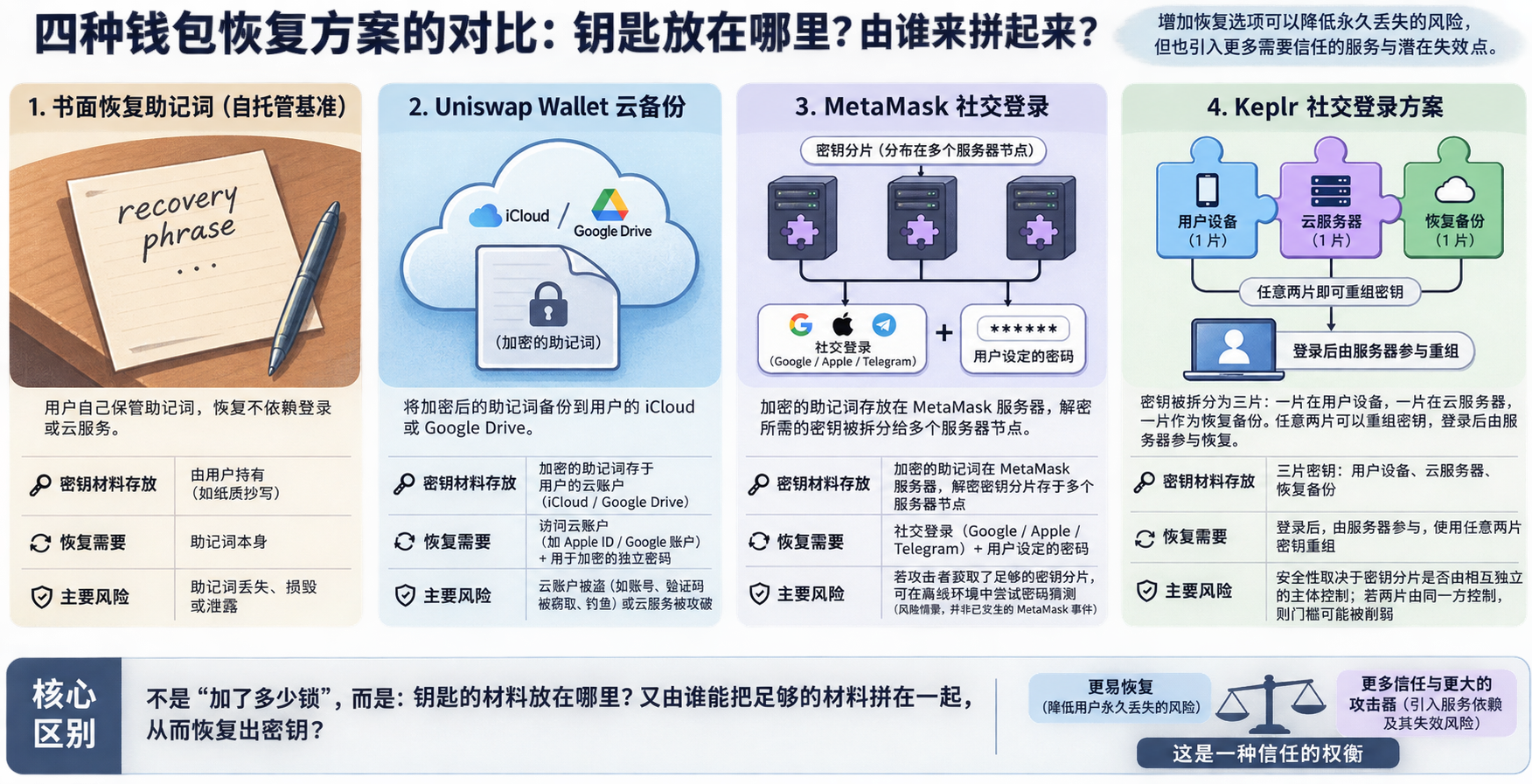
- A written recovery phrase: The user keeps the phrase and bears the risk of losing it or exposing it. Recovery does not depend on a login or cloud service.
- Uniswap Wallet cloud backup: In Liu’s description, an encrypted recovery phrase is backed up to the user’s iCloud or Google Drive. Recovery requires access to that cloud account and a separate password used to encrypt the phrase. The cloud provider holds the encrypted backup, not the password needed to decrypt it.
- MetaMask social login: Liu described an encrypted phrase stored on MetaMask servers, with the decryption key split among server nodes. Recovery uses both a Google, Apple or Telegram login and a user-set password. Liu argued that if an attacker obtained the necessary shares, they could attempt password guesses offline, outside the rate limits of an online recovery process. That is a risk scenario, not a reported breach of MetaMask.
- Keplr’s social-login arrangement: According to Liu, the key is split into three shares: one on the user’s device, one on a cloud server and one for recovery backup. Any two shares can reconstruct the key, with a server participating after login. Liu argued that the security benefit of this threshold depends on whether the shares are controlled independently. The account did not establish that one provider controlled two shares or that this caused the reported incident.
The distinction is between where key material is stored and who can bring enough of it together to recover a key. Adding recovery options may reduce the chance that a user permanently loses access, but it also introduces services whose control and failure modes a user may not be able to assess. Liu’s account presents that as a trust trade-off; without further technical disclosure, it does not identify the failure that led to the reported Keplr losses.