As reported on November 10, 2026, two infrastructure developments concerned different forms of custody and control: Coinbase said it had received a formal U.S. national trust bank charter, while the Hyperliquid-ecosystem L2 Elysium announced its mainnet launch. A bank charter and a blockchain launch answer different questions, so their operational boundaries matter more than the labels alone.
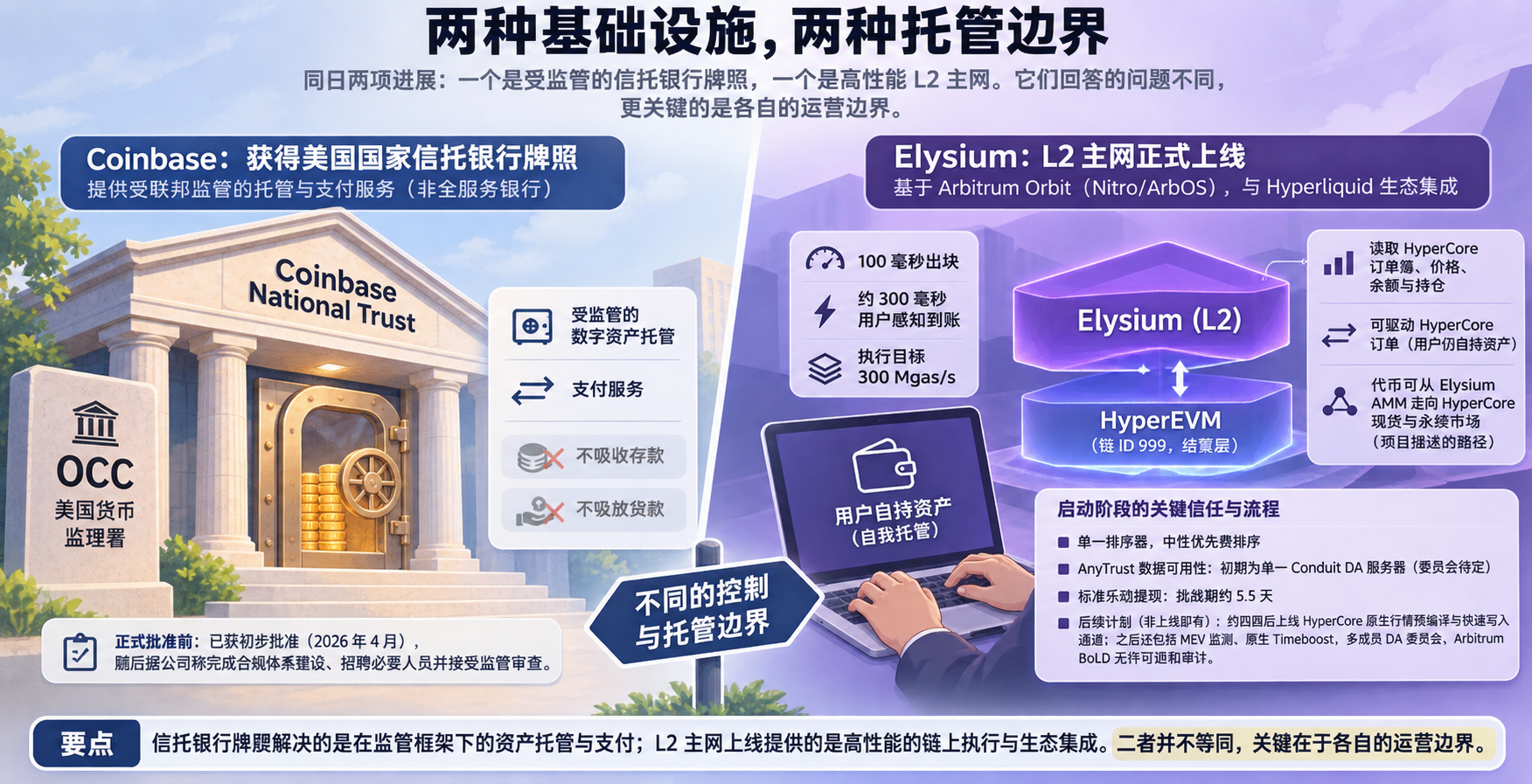
Coinbase: a trust charter, not a full-service bank
Coinbase said the U.S. Office of the Comptroller of the Currency (OCC) had formally approved a national trust bank charter for Coinbase National Trust, according to CoinDesk. The charter had previously received conditional approval. Coinbase National Trust obtained preliminary approval in April 2026 to provide federally regulated custody and payment services; it will not operate as a full-service bank taking deposits and making loans.
Coinbase attributed the formal approval to work over the intervening months to establish compliance systems, hire required staff and undergo regulatory review. Those are the company’s account of the process, not evidence that its trust-bank services are equivalent to deposit banking.
Elysium: launch specifications and remaining dependencies
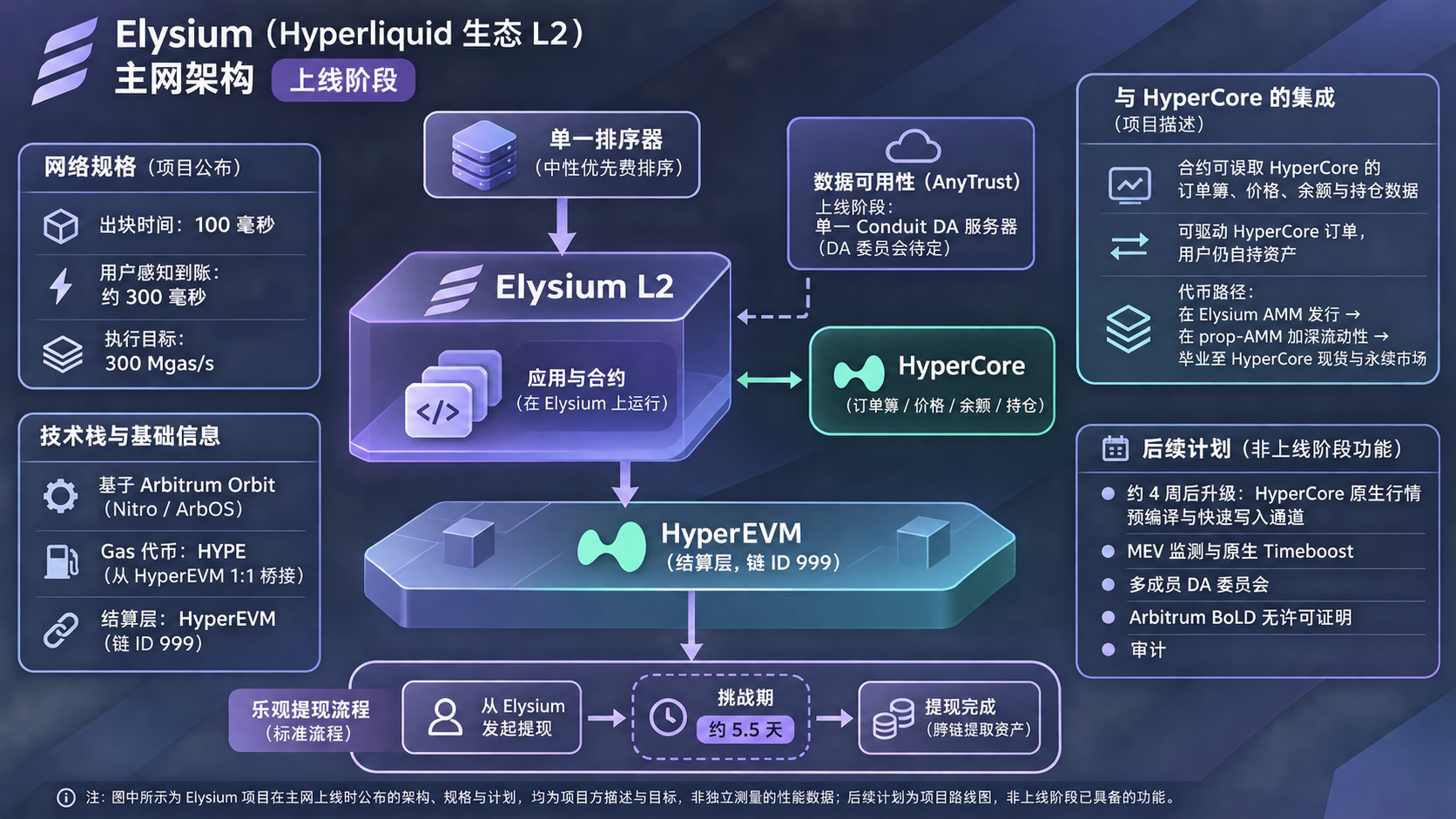
Elysium, an L2 built by the Kinetiq team and operated by Conduit, announced its mainnet launch. Its documentation describes a network based on Arbitrum Orbit’s Nitro/ArbOS stack, using native HYPE bridged 1:1 from HyperEVM as its gas token and settling on HyperEVM, chain ID 999.
The project lists 100-millisecond block times, approximately 300-millisecond user-perceived receipt and a 300 Mgas/s execution target. These are project-published specifications and targets, not independently measured performance in the supplied report.
Its launch-stage trust assumptions are more concrete: Elysium uses a single sequencer and neutral priority-fee ordering. Its AnyTrust data-availability arrangement initially relies on one Conduit DA server, with a committee yet to be determined. Standard optimistic withdrawals have an approximately 5.5-day challenge period. A fast receipt on Elysium therefore should not be confused with completion of a withdrawal through that challenge process.
Elysium says contracts can read HyperCore order-book, price, balance and position data, and can drive HyperCore orders while users retain custody of their assets. The project also describes a possible path for tokens from an Elysium AMM to HyperCore spot and perpetual markets. These are descriptions of its intended integration, not evidence of adoption or trading volume.
At the time of the November 10 report, native HyperCore market-data precompiles and a fast write channel were planned for an upgrade about four weeks after mainnet. MEV monitoring, native Timeboost, a multi-member DA committee, Arbitrum BoLD permissionless proving and audits were also listed as subsequent plans—not launch-stage features.