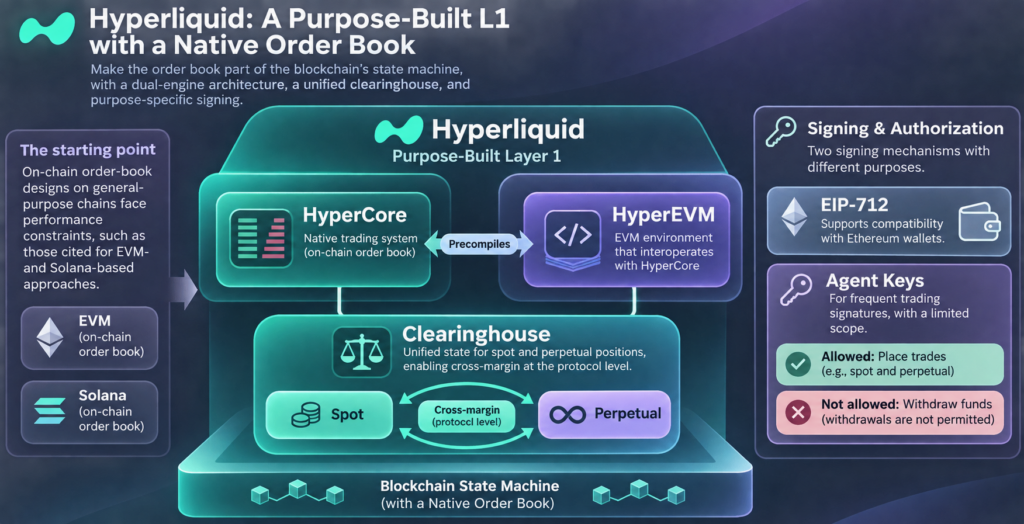
What does it mean to make an order book part of a blockchain’s state machine? In an account published on November 16, 2026, Hyperliquid’s answer was a purpose-built Layer 1: rather than run the order book inside a general-purpose smart contract, it makes the order book part of the chain’s native state. The account frames this choice around performance constraints in EVM- and Solana-based on-chain order-book designs; it does not provide benchmark figures.
The architecture described has two parallel components. HyperCore handles the native trading system, while HyperEVM interoperates with it through precompiles. A Clearinghouse brings spot and perpetual positions into a unified state, enabling cross-margin at the protocol level.
The account also describes two signing mechanisms with different purposes. EIP-712 supports compatibility with Ethereum wallets. Agent Keys address frequent trading signatures while, as described, limiting an agent to trading rather than withdrawals. That distinction matters when reading the authorization model: permission to place trades is not the same as permission to move funds out.