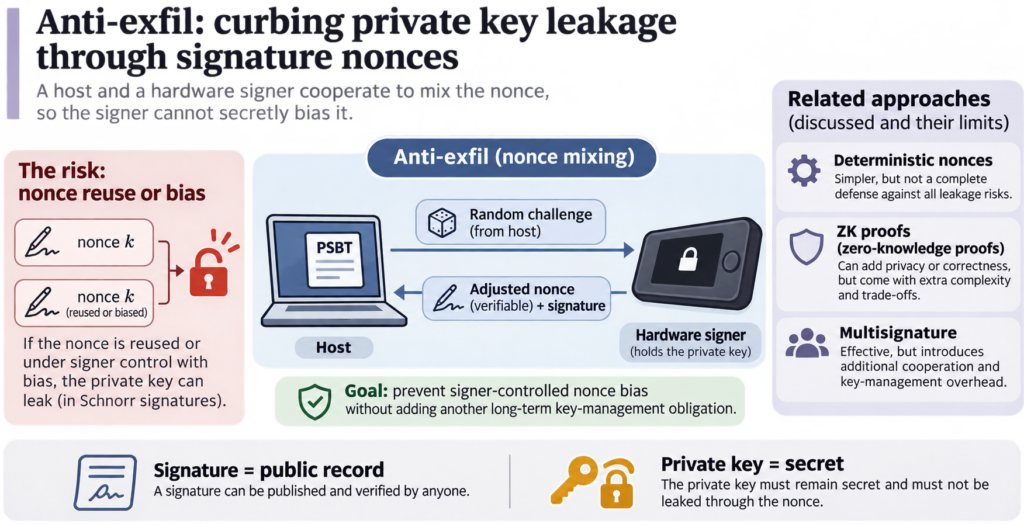
A signature is a public record, but the nonce used to create it must not become a channel for leaking the private key. In a transcript published on November 15, 2026, Andrew Poelstra’s Silicon Salon IV talk examines that risk in hardware signers, using Schnorr signatures to explain why nonce reuse or bias matters.
Poelstra discusses the limits of deterministic nonces, zero-knowledge proofs and multisignature approaches before describing anti-exfil as a weaker form of multisignature cooperation between a host and a signer. The host supplies a random challenge; the signer produces an adjusted nonce that the host can verify. The proposed aim is to prevent signer-controlled nonce bias without adding another long-term key-management obligation. That describes the protocol’s intended protection, not proof that any particular device is free of leakage.
The transcript also discusses Blockstream Jade’s implementation, its PSBT interaction and a historical application involving OpenTimestamps. It does not provide transaction records or measurements from which to assess real-world leakage.