
A confirmed transaction does not necessarily mean every payment inside it succeeded. In a report published on November 17, 2026, TechFlow described Juicebox simulations on Ethereum’s Sepolia test network in which an outer transaction completed while an internal payment ran out of gas. The finding concerns proposed Glamsterdam upgrade rules under test, not an enacted mainnet change.
According to the Juicebox technical documentation cited in the report, an NFT purchase test gave the buyer the NFT even though the internal payment to an associated project failed; the unpaid funds remained in the paying project. In a token-distribution test, reserved tokens were allocated, but a cross-project payment stopped. The beneficiary received the project’s original tokens rather than the intended cross-project payment result.
A cash-redemption test showed a separate fee risk. Within the reported range of 679,622 to 817,622 gas, users completed redemptions while an internal payment of the 2.5% protocol fee did not execute. These are reported test outcomes, not evidence that the same fee behavior occurred on mainnet.
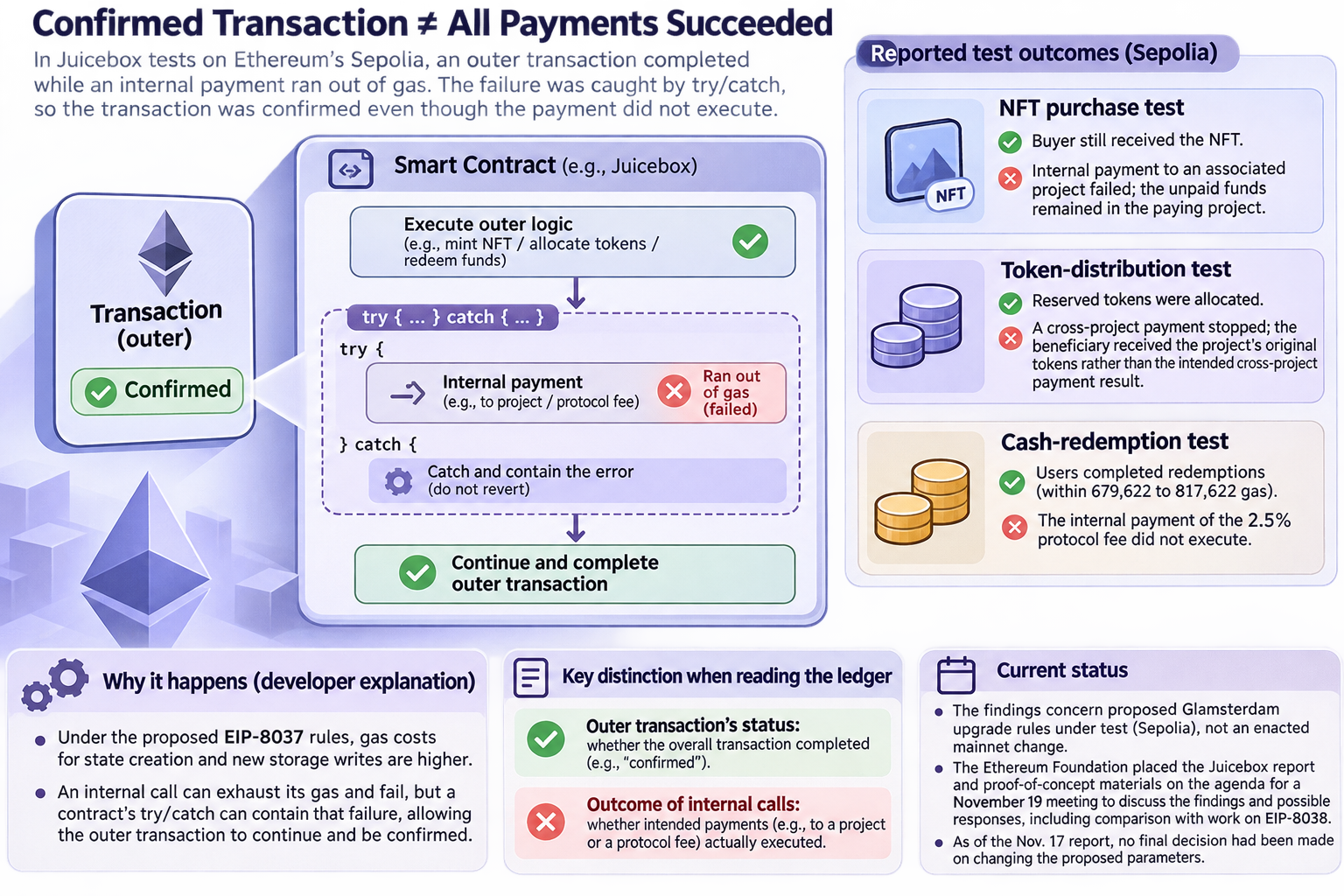
Juicebox developer mejango linked the behavior to higher gas costs for state creation and new storage writes under the proposed EIP-8037 rules, combined with existing contracts’ error handling. An internal call can exhaust its gas and fail, but a contract’s try/catch can contain that failure, allowing the outer transaction to continue and be confirmed. The report says comparable mainnet simulations in the same gas range produced either a fully failed transaction or a completed payment, not a silently skipped internal payment.
For someone reading the resulting ledger record, the distinction is between the outer transaction’s status and the outcome of its internal calls. A successful status alone would not establish that the intended recipient was paid or that a protocol fee was collected.
As of the November 17 report, the Ethereum Foundation had placed the Juicebox report and proof-of-concept materials on the agenda for a November 19 meeting to discuss the findings and possible responses. The report also mentions comparison with work on EIP-8038. It says no final decision had been made on changing the proposed parameters.