Originally reported by Decrypt on November 15, 2026, at 00:01 UTC+8. The developments and figures below reflect that reporting period.
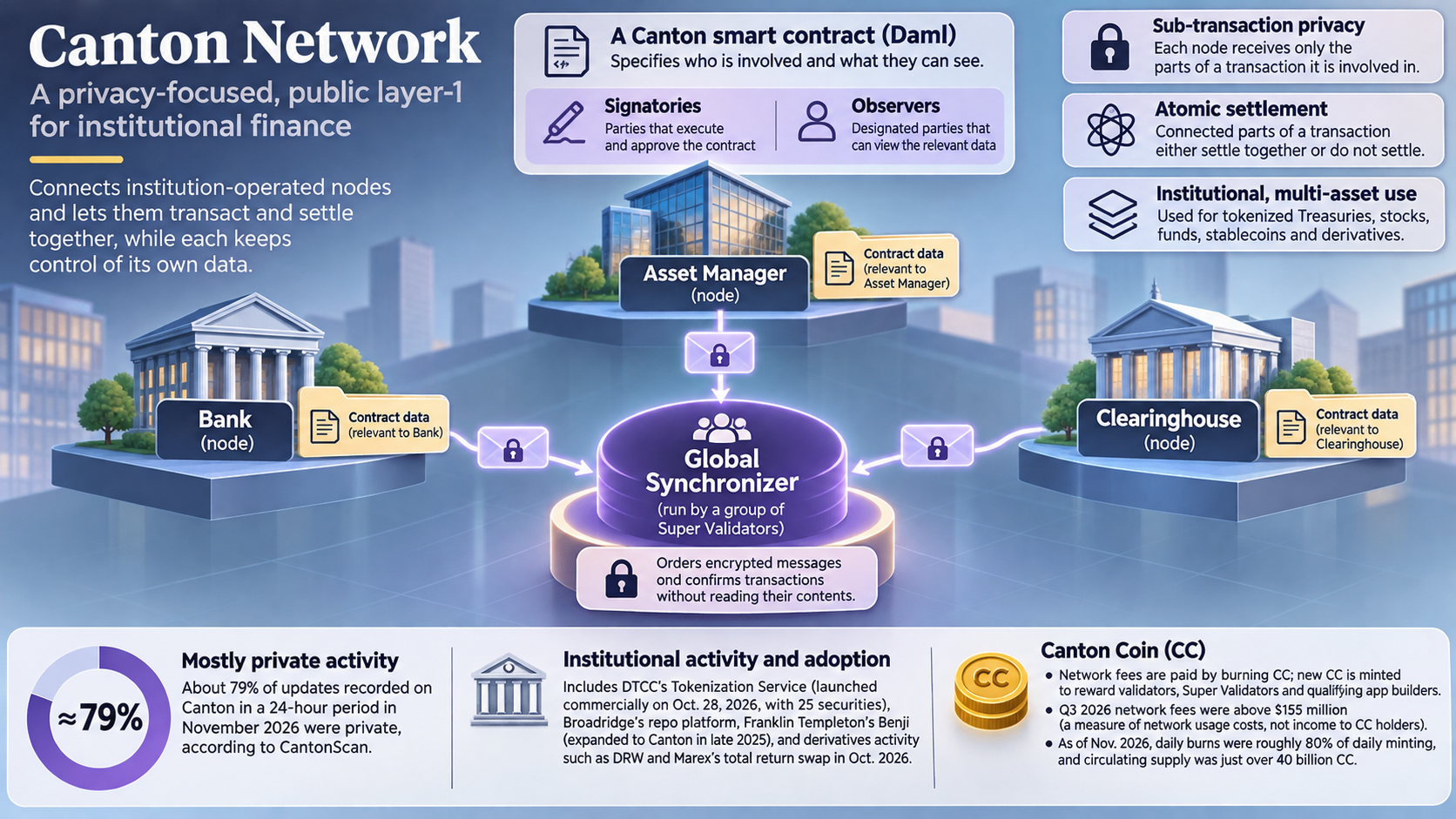
Canton Network raises a basic ledger question: who must see a transaction for it to settle across institutions? On a conventional public blockchain, nodes generally replicate the same state changes. Canton, a public layer-1 network developed by Digital Asset, instead connects institution-operated nodes that retain the data relevant to them. Its shared Global Synchronizer coordinates transactions between those nodes.
What a participant can see
Canton applications use Daml, Digital Asset’s open-source contract language, to specify each contract’s signatories and observers. According to Canton’s documentation, a participant’s node receives only the portions of a transaction in which it is involved. The Global Synchronizer, operated by a group of Super Validators, orders encrypted messages and confirms transactions without reading their contents.
That division is central to Canton’s trust model: participating institutions hold their own transaction data, while the shared synchronizer coordinates activity between them. Canton describes cross-node settlement as atomic: the connected parts of a transaction either settle together or do not settle. In a 24-hour period in November 2026, about 79% of updates recorded on Canton were private, according to CantonScan. That figure describes the recorded updates in that observation window, not the contents of private transactions.
From pilot to institutional services
Digital Asset launched Canton in May 2023 with a pilot group that included Goldman Sachs, Deloitte and Microsoft. The Global Synchronizer and Canton Coin went live in July 2024. The Global Synchronizer Foundation, an independent body hosted by the Linux Foundation, governs the network.
In July 2026, DTCC processed production trades using DTC-tokenized U.S. Treasuries and equities on Canton. DTCC’s Tokenization Service launched commercially on October 28, 2026, initially covering 25 securities drawn from Russell 1000 stocks, major ETFs and Treasuries, according to a DTCC fact sheet. The service runs on Canton and DTCC’s private Besu network. DTCC also plans connections to Stellar, Circle’s Arc and Solana in 2027; those connections were plans, not completed integrations at the time of the original report.
Other reported activity includes Broadridge’s distributed-ledger repo platform and Franklin Templeton’s Benji fund platform, which expanded to Canton in late 2025. In October 2026, DRW and Marex executed a total return swap on a Canton-tokenized iBoxx investment-grade benchmark through Derivnex. It was billed as the first OTC derivative referencing a fully tokenized index. World Liberty Financial launched its USD1 stablecoin on Canton in August 2026, while J.P. Morgan’s Kinexys planned a phased 2026 rollout of its JPMD deposit token.
Visa became a Super Validator in March 2026, Franklin Templeton in August, and LSEG was appointed in September. Shinhan Asset Management was approved in September as the first Korean financial institution to become a Super Validator. Fireblocks added Canton support, and Ripple Custody integrated with the network in October. These roles and integrations should not be conflated with a single, network-wide view of private transaction data.
What the CC figures measure
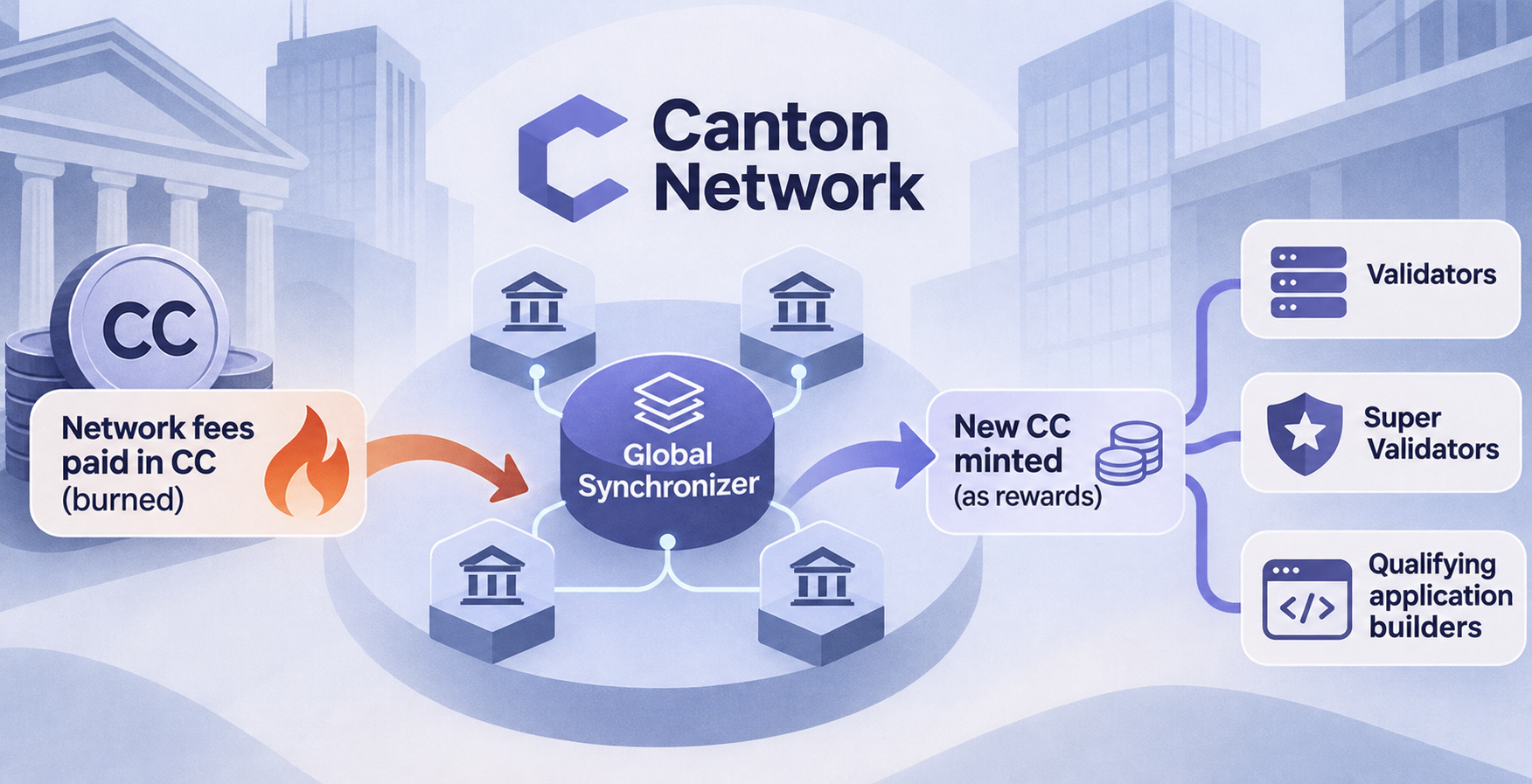
Canton Coin (CC) is the Global Synchronizer’s native utility coin. Network fees are paid by burning CC; new CC is minted to reward validators, Super Validators and qualifying application builders. CertiK’s comparison put Canton’s third-quarter 2026 network fees above $155 million. Because fees burn CC, that amount represents network usage costs, not income distributed to CC holders.
Canton says CC had no pre-mine or venture-capital allocation. As of November 2026, CantonScan data indicated daily burns were roughly 80% of daily minting—below the one-to-one level at which that balance would begin reducing supply. Circulating supply was just over 40 billion CC. In November 2026, SEC staff granted no-action relief concerning CC’s minting and said they viewed it as a digital commodity; this was a staff enforcement position, not a blanket regulatory approval.
Digital Asset raised $355 million in June 2026, following a $135 million round in June 2025. Those funding figures and the institutional projects above show participation, but they do not establish how much transaction data is publicly observable or predict future network usage.
Source: decrypt.co (originally published 2026-11-15 00:01 UTC+8)