A report by Sanqing for Foresight News, published on Odaily on November 10, 2026 at 18:00 (UTC+8), reconstructs a settlement design the New York Stock Exchange described the day before. The record question is which ledger would store tokenized-stock settlement, which participation rules that ledger is built to enforce, and which AVAX entries—if any—the design would create. Dates below are the ones given in that article. Where the article does not name a year, the unmarked months sit in the publication year, 2026; it does name 2024 when referring to an earlier window.
What was stated on November 9, 2026
On November 9, 2026, the Wall Street Journal reported that the NYSE said its forthcoming 24/7 tokenized-securities trading platform would settle tokenized stocks only on Avalanche. The same day, Ava Labs said Avalanche would provide core ledger technology for the clearing company of this NYSE-related platform. NYSE pre-market information that day also confirmed the point.
The platform is described as an alternative trading system (ATS). The stated aim was a fourth-quarter launch. As of the report, regulatory approval was still outstanding.
The article also records a price snapshot from Bitget, which is an exchange quotation, not a ledger measurement. After the news, AVAX reached a high of 9.01 USDT and was quoted at 8.627 USDT at the time of publication, a 6.86% change over 24 hours. That timestamp does not measure settlement count, notional settled, or tokens burned.
Two records: a match, then a settlement entry
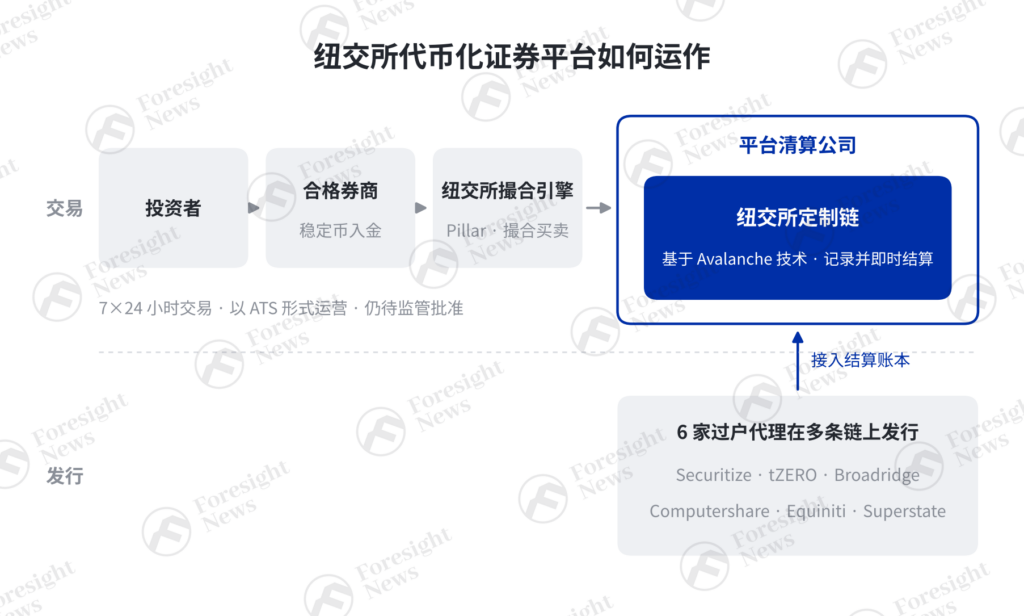
Under the design disclosed on November 9, matching would continue on the NYSE’s existing Pillar engine. After a match, the platform’s clearing company would settle immediately on an Avalanche ledger. The report says investors could deposit with stablecoins.
John Nahas, chief business officer at Ava Labs, said in an interview that the NYSE would not settle on Avalanche’s public chain. It would operate a blockchain based on Avalanche technology and tailored to regulatory requirements.
Issuance had been set out a week earlier, on November 2. Beyond Securitize and tZERO, the NYSE added Broadridge, Computershare, Equiniti, and Superstate as transfer agents, taking the partner count to six. Tokens on the platform are split into two issuance types: those issued by a custody institution and those issued by the issuer. Both are described as interchangeable with the traditional shares, and holders are described as having the same dividend and voting rights.
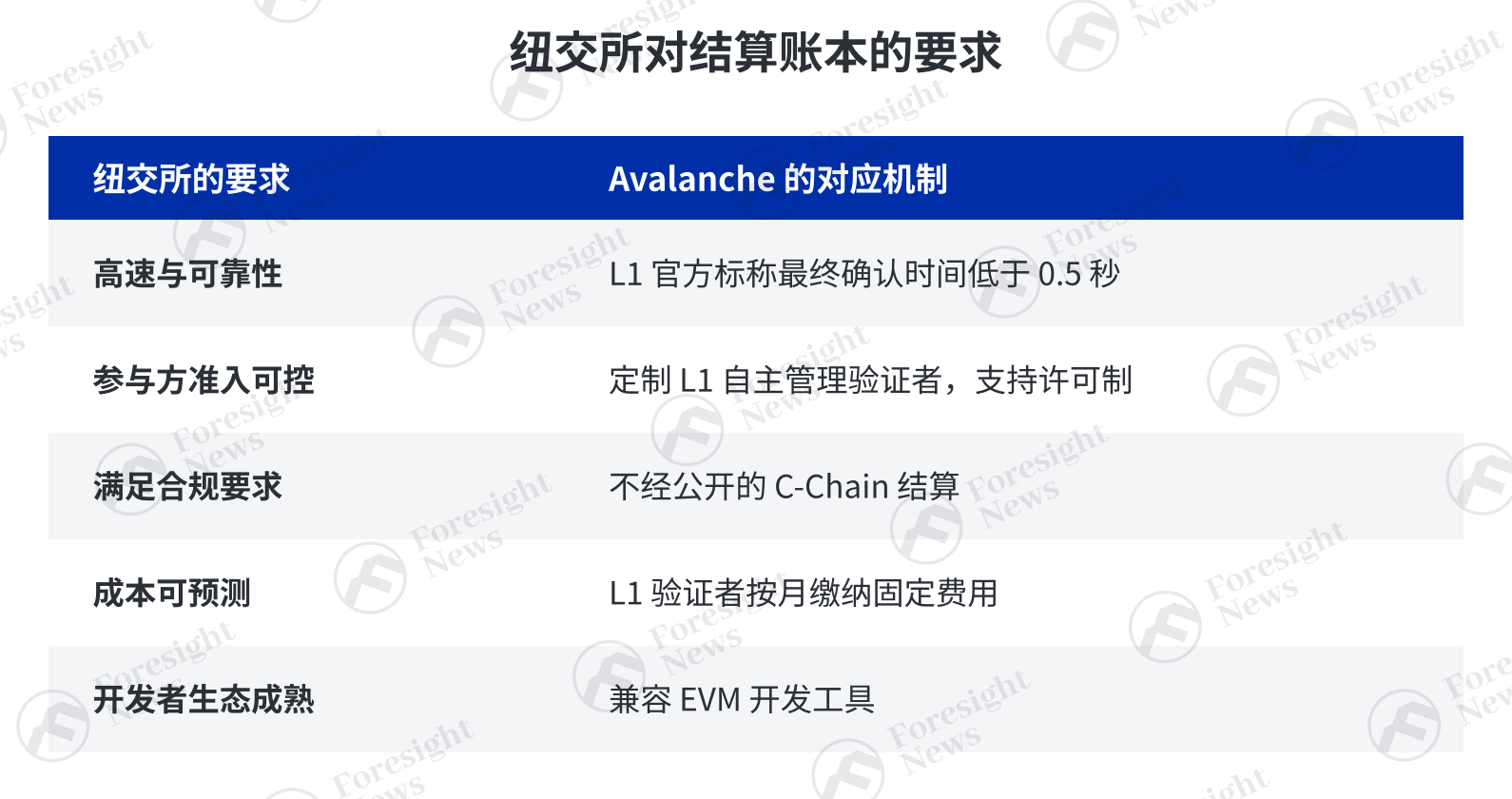
Dennis Lee, head of digital issuance at the NYSE, said the platform can support stocks issued on multiple chains, but the ledger that records and settles trades needs to be fast and reliable, able to control participants, predictable in cost, and supported by a large developer community. He said Avalanche met all of those conditions. The split that follows is between records, not a claim about volume: issuance can be spread across several transfer agents and several chains, while settlement is gathered onto the NYSE’s own chain.
How the article sequences the selection
On January 19, the NYSE said it was developing the platform and seeking regulatory approval. On August 31, parent company Intercontinental Exchange (ICE) signed a memorandum of understanding with tZERO. At the Avalanche Summit in September, Ava Labs president Charley Cooper said the NYSE had tested Avalanche for about a year, and that a selection had not been announced then. On the November 9 NYSE Live program, Cooper said this step was a deployment for a production environment, not another pilot.
The January announcement had described support for multiple chains for settlement and custody. By November, the stated settlement choice had narrowed to Avalanche only. Kevin Tyrrell, the NYSE’s chief product officer, said several vendors were tested beforehand, with attention to speed, throughput, and the ability to support a controlled network and compliance requirements. Nahas said the technical, commercial, and ecosystem review before selection took more than a year.
Public C-Chain versus a permissioned L1
Of the conditions Lee listed, control of participants is described as the critical one. Parties to stock settlement must be admitted. The C-Chain on Avalanche mainnet is a public chain: anyone can connect, so it does not meet that rule.
The NYSE custom chain corresponds to the self-built L1 model introduced after Avalanche’s Etna upgrade (ACP-77). These chains were previously called Subnets. An institution’s L1 runs independently of the mainnet and manages its own validator set. It can be permissioned. Validators do not have to stake 2,000 AVAX and become mainnet validators first. They pay a fixed monthly fee, which is the feature tied to predictable cost.
On the separate question of isolation from outside activity, Ava Labs CEO Emin Gün Sirer said in the announcement that this dedicated infrastructure could still connect to a broader set of assets and liquidity, and that Avalanche L1s can communicate through native cross-chain messages. That is a stated property of the design. The report does not present counts of messages, settlements, or balances for an NYSE chain, and the platform had not launched.
Avalanche RWA figures cited for the same date
The article cites rwa.xyz as of November 9, 2026. The two RWA categories are different objects and are not summed here:
- Distributed RWA, defined as freely transferable between wallets: 1.43 billion USD.
- Represented RWA, defined as ownership registered on-chain only: 11.4 billion USD.
- Stablecoin market value: 795 million USD.
These are aggregates for Avalanche on that date. They are not balances on the NYSE clearing ledger.
Which entries touch AVAX
Neither the Ava Labs announcement nor the NYSE statement, as recounted in the report, mentioned a use for the AVAX token in settlement, in fees, or in staking on this platform.
Under the custom-L1 mechanism the article describes, direct AVAX intake is the ongoing validator fee. Avalanche documentation, as cited, says that when an L1 has fewer than 10,000 validators, each validator pays about 1.33 AVAX per month and those tokens are burned. The payment is not a function of settlement count or settlement amount. Fees inside the L1 can be denominated in a token the operator chooses.
Observation and inference should stay separate. The design, as stated, puts trade settlement on the custom ledger and does not describe an AVAX debit per trade. The only AVAX-denominated flow the article ties to that chain is the validator fee, which does not scale with the trades.
What the foundation had already measured and what it had not
On July 30, when the Avalanche Foundation published an economic research agenda, it acknowledged that value created by the ecosystem does not automatically flow to the AVAX that secures the network. Chief investment officer Matias Antonio called this a core problem the foundation was working on.
An estimate the foundation released on August 12 said that, in the on-chain economic activity it counted, the main capture into AVAX at that time was C-Chain fee burns: about 23.5 million USD cumulative since the beginning of 2024, excluding L1 validator fees. L1 revenue sharing was still being studied, with no mechanism decided.
The latest month inside that estimate was June. Nominal on-chain GCP, described as analogous to on-chain GDP, was 3.1 million USD. Returns to holders from assets such as tokenized funds were 2.7 million USD. Earnings issuers took from reserve assets were 6.9 million USD. The foundation’s stated view was that the latter two were then contributing essentially nothing to AVAX value capture.
Directions the foundation listed—all still in research—were ACP-283, under which validators would vote to adjust the gas price; ACP-67, a protocol-owned stablecoin; and revenue sharing from applications and L1s.
Read against those rules, settlement on the NYSE custom chain would also sit outside AVAX capture, aside from the validator fee. The C-Chain, described as the main capture channel then, was not large in fees on the announcement day either. DefiLlama figures cited in the report put Avalanche C-Chain fees on November 9, 2026 at about 26,500 USD. A one-day total on a different chain is not a forecast for the NYSE ledger and is not a count of its trades.
On the day the news appeared, the Avalanche Foundation posted that it would follow the platform’s activity, and that activity’s place in the Avalanche economy, through the economic research agenda. The post, as reported, is a tracking statement. It does not specify a fee, a burn, or a revenue split.
The article’s closing status is unchanged from the launch description above: a fourth-quarter target, and regulatory approval still required before that.
Original article: Sanqing, Foresight News, published on Odaily, November 10, 2026, 18:00 (UTC+8): https://www.odaily.news/post/5213851